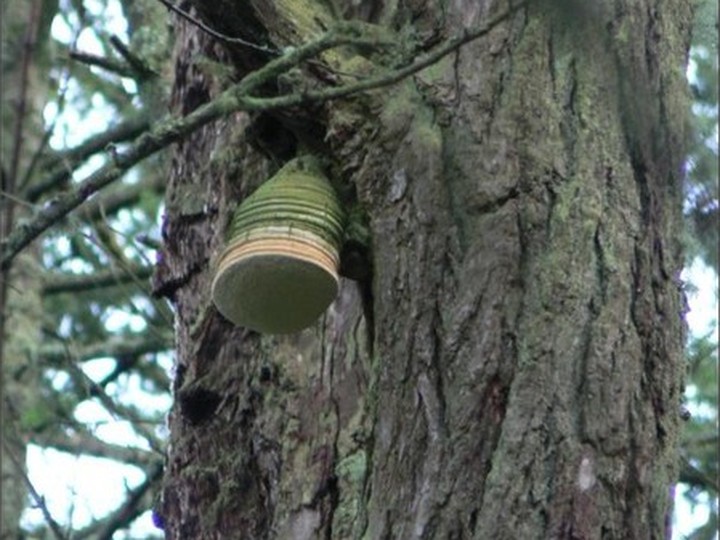
Agarikon (Fomitopsis officinalis), old-growth conifer wild harvest
A century-old bracket fungus once called 'bread of the ghosts' by Pacific Northwest coastal peoples, Agarikon is among the rarest medicinal polypores on Earth, now IUCN-listed as Endangered.
| Origin | Old-growth conifer forests (larch, fir, hemlock) of the Pacific Northwest, USA — but note the species is IUCN Red List 'Endangered', so any wild-harvest offering must be framed as legacy/salvaged specimens or law-compliant collection, not routine felling. |
| Indian subcontinent | No |
| Category | Fungi & Functional Mycology |
| Retail price band | Retail: consumer tincture/powder products (10–15% actual Agarikon fruiting-body content blended with mycelium) run US$25–60 for 30–100g; true wild fruiting-body chunks, where sold at all, fetch US$150–400+ per 100g via specialty herbal/mycology retailers, reflecting extreme scarcity rather than a liquid commodity market. |
| Bulk / trade price band | No established wholesale/bulk trade lane exists — Agarikon is not farmed at scale (cultivation on larch bolts is experimental) and legitimate wild conks are only occasionally found on standing old-growth trees; any 'bulk' offer should be treated as a bespoke, provenance-verified allocation, not a repeatable SKU. |
| Sourcing status | Dossier researched from public sources — producer contact not yet established |
| Compliance status | Preliminary review complete (see below) — not yet legally verified |
Detailed study
Laricifomes officinalis (formerly Fomitopsis officinalis), commonly called Agarikon, is a long-lived wood-decay polypore of old-growth conifers across the northern hemisphere. Ancient Greek physician Dioscorides recorded its medicinal use (including for what he called consumption) around 65 CE, and Pacific Northwest First Nations (Tlingit, Haida, Tsimshian) revered it as 'bread of the ghosts' with ceremonial and medicinal roles. Mycologist Paul Stamets has researched Agarikon extracts for antiviral activity (including against pox and flu viruses) via Fungi Perfecti/Host Defense and NIH-funded work.
Provenance & producer
Genuine fruiting bodies form only on very old (often 100+ year) living or recently dead conifers, mainly larch, fir and hemlock, in undisturbed old-growth stands of the Cascades and Olympic Peninsula region of Washington/Oregon; Stamets has documented specimens estimated to be decades to over a century old. Because the fungus requires intact old-growth habitat, legitimate wild collection is opportunistic and rare, and most commercial 'Agarikon' products are cultivated mycelium-on-grain biomass rather than harvested conks.
Market & pricing
Retail supplement listings (Host Defense, Fungi Perfecti-adjacent brands) price capsule/powder products with partial Agarikon content at roughly US$25–60 per bottle; genuine dried fruiting-body chunks, sold rarely by specialty mycological suppliers, have been reported in the US$150–400 per 100g range, but there is no liquid commodity exchange or published index price — figures are drawn from individual retailer listings, not a market benchmark.
Compliance & export
IUCN Red List assesses Fomitopsis/Laricifomes officinalis as Endangered (EN, criterion A2ad), citing a 70–75% historical population decline from old-growth logging and overharvesting for traditional medicine. It is legally protected in Germany, Lithuania, Poland and Slovenia; it is NOT currently CITES-listed, and in the US Pacific Northwest it has no special protected-species status beyond general national-forest special-forest-products permitting, but its Endangered IUCN status makes large-scale wild-harvest marketing ethically and reputationally sensitive — Vasundhara should source only cultivated mycelium biomass or clearly document provenance of any true wild specimen (permit, tree age, non-destructive removal).
Sources
- Laricifomes officinalis IUCN Red List assessment (redlist.info mirror)
- Wikipedia: Laricifomes officinalis
- Paul Stamets — Deep dive: Fomitopsis officinalis Agarikon
- Fungi Perfecti — The Search for Agarikon
- SafeShrooms — Agarikon Mushroom: The Rarest Functional Fungus
- Amazon listing — Agarikon Mushroom Powder 100g (retail price reference)
Image status
A working reference photograph is in place, captured from a freely-licensed Wikimedia Commons source (File:Fomitopsis officinalis 32014.JPG). Hosted in Commons Category:Fomitopsis officinalis; Commons file pages for this category are typically released under a CC BY-SA licence (version stated on the individual file page) — confirm exact licence text on the file page before use. An alternative candidate is File:Paul Stamets with Agarikon.jpg for a provenance/human-context shot. Treat this as a placeholder for marketing purposes: exact licence terms should be re-verified on the Commons file page, and original producer photography is recommended before final trade use.