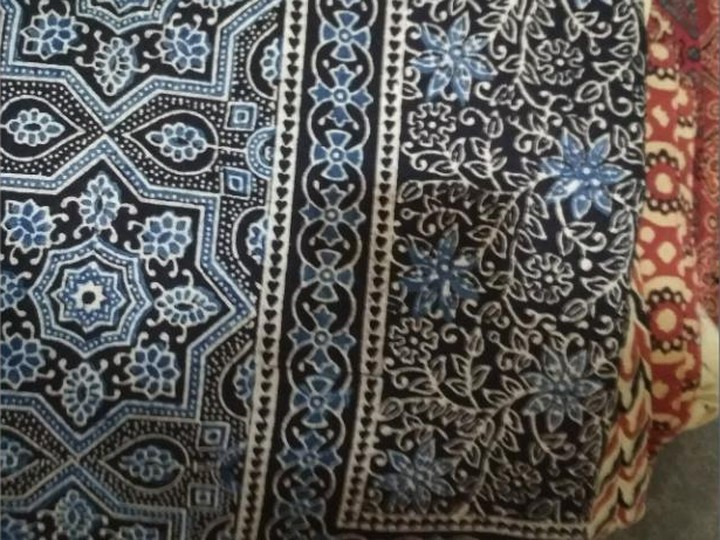
Ajrakh hand block-printed textile, natural dyes
Indigo, madder and fourteen hand-carved blocks — Kutch's resist-dyed textile art.
| Origin | Ajrakh is a shared cross-border craft: the same resist-block-printing tradition, using natural indigo and madder dyes, is practised in Sindh, Pakistan (Matiari, Hala, Hyderabad) as well as in Kutch, Gujarat and Barmer, Rajasthan in India. The catalogue's 'Kutch, Gujarat' attribution is accurate and specific (Kutch Ajrakh received its own distinct GI tag in 2024, separate from Sindhi Ajrak), but sellers should avoid implying Ajrakh is exclusively an Indian/Kutch invention — it is a shared Indus-region heritage craft. |
| Indian subcontinent | Yes |
| Category | Heritage Textiles & Weaves |
| Retail price band | mid |
| Bulk / trade price band | budget |
| Sourcing status | Dossier researched from public sources — producer contact not yet established |
| Compliance status | Preliminary review complete (see below) — not yet legally verified |
Detailed study
Ajrakh printing uses hand-carved wooden blocks and a multi-stage natural resist-dye process (indigo, madder/alizarin, iron and lime-based resists) applied in up to 16 sequential steps per side of the cloth, producing deep, symmetric geometric patterns with characteristic small dot motifs. Genuine Ajrakh is dyed, not surface-printed, meaning the pattern penetrates and is colourfast on both faces of the fabric.
Provenance & producer
Kutch Ajrakh is produced primarily by Khatri artisan families in villages such as Ajrakhpur and Dhamadka, Kutch district, Gujarat, with the technique's roots traced to the Indus Valley civilization (a possible Ajrakh-like pattern appears on a Mohenjo-daro figurine) and Mughal-era geometric design influence. 'Hand Block Printing and Dyeing of Ajrakh in Kutch' received formal GI certification in 2024.
Market & pricing
Kutch Ajrakh spans budget cotton stoles/dupattas to premium natural-dyed yardage and garments, appealing to sustainable-fashion and slow-textile buyers internationally as well as domestic ethnic-wear retail; natural-dye, hand-block pieces command a meaningful premium over the widespread chemical-dye, screen-printed 'Ajrakh-print' fast-fashion copies.
Compliance & export
Since the 2024 GI specifically covers Kutch-origin Ajrakh, marketing must not imply GI protection extends to Sindhi (Pakistani) or Barmer (Rajasthan) Ajrakh sold under the same name; natural indigo/madder dye claims should be verifiable, as many commercial 'Ajrakh' textiles now use synthetic dyes, which is a labeling and consumer-protection issue for both GI compliance and export markets requiring azo-dye-free certification (e.g. EU REACH).
Sources
- Wikipedia - Ajrak
- Outlook Traveller - Ajrakh from Kutch Gets GI Tag
- Editorji - Gujarat's Ajrakh block printing gets GI tag
Image status
A working reference photograph is in place, captured from a freely-licensed Wikimedia Commons source. Ajrak block print textile in indigo blue, black and white geometric motifs, SMarndi, CC BY-SA 4.0, via Wikimedia Commons. Note: photographed among Sindh-region ajrak cloth; illustrative of the same ajrak/ajrakh block-printing tradition shared across the Sindh-Kutch region, not documented specifically as Kutch, Gujarat, India as claimed for this listing. Treat this as a placeholder for marketing purposes: exact licence terms should be re-verified on the Commons file page, and original producer photography is recommended before final trade use.