Basra-style natural pearl jewellery (Gulf-sourced heritage trade)
The legendary Gulf pearl of the Nizams — a vanishing natural gem, now honestly graded and provenance-certified.
| Origin | Flag: true wild/'natural' Basra pearls from historic Persian Gulf oyster beds are now commercially near-extinct — Gulf natural pearl fisheries collapsed by the mid-20th century due to overfishing, pollution and the rise of Japanese cultured pearls, and the Gulf itself no longer has a meaningful natural pearl harvesting industry. Any 'Basra-style natural pearl' item sold today is overwhelmingly likely to be either (a) genuine antique/estate natural pearls recirculated through the secondary/auction market, carrying real scarcity value, or (b) modern cultured (or imitation) pearls marketed loosely under the historic 'Basra pearl' name — a practice considered misleading without clear disclosure. Hyderabad is correctly framed as a historic trading/processing hub (pearls arrived via Gulf trade routes to be drilled, matched and set by Hyderabadi karigars), not a pearl source itself. |
| Indian subcontinent | Yes |
| Category | Gems, Metalwork & Craft |
| Retail price band | luxury |
| Bulk / trade price band | N/A — natural pearl inventory is one-off/estate; no meaningful bulk tier |
| Sourcing status | Dossier researched from public sources — producer contact not yet established |
| Compliance status | Preliminary review complete (see below) — not yet legally verified |
Detailed study
Historic 'Basra pearls' are natural (non-nucleated, non-cultured) saltwater pearls once harvested by free-divers from Pinctada oyster beds in the Persian/Arabian Gulf and traded through the port of Basra; true natural pearls form entirely by chance without human intervention, making each one irregular and genuinely rare, unlike cultured pearls which are seeded and farmed at scale.
Provenance & producer
Hyderabad (Deccan) became the subcontinent's principal pearl-trading and processing hub from the Nizam era onward — Gulf pearls were imported via historic trade routes, then drilled, sorted, matched and strung by specialist Hyderabadi pearl merchants and karigars in the Old City's Pather Gali/Laad Bazaar cluster, a role that continues in Hyderabad's contemporary pearl trade even though pearls are no longer harvested in the Gulf at any scale.
Market & pricing
Genuine antique natural Basra pearls trade at very high premiums at auction and through specialist estate-jewellery dealers owing to extreme scarcity; the wider Hyderabad pearl market today is dominated by cultured freshwater and Gulf-region-sourced saltwater cultured pearls sold at accessible mid-to-premium price points, with 'Basra' frequently used (and often loosely/misleadingly) as a marketing term rather than a literal source guarantee.
Compliance & export
Any item marketed as 'natural' pearl must be backed by an independent gemological laboratory report (e.g., GIA, SSEF, Gübelin, or a recognised Indian gem-testing lab) explicitly distinguishing natural from cultured/treated origin via X-radiography/real-time microradiography — selling cultured or imitation pearls under the unqualified 'Basra' or 'natural pearl' label without such certification risks consumer-protection and mis-description liability in most export markets, and listings should state natural vs. cultured status explicitly per FTC (US), CBI/EU, and Indian BIS jewellery-trade disclosure norms.
Sources
- Siasat — The pearl that connected Hyderabad and Basra
- Wikipedia — Hyderabadi pearls
- GIA — Spotlight on Natural Nacreous Pearls
Image status
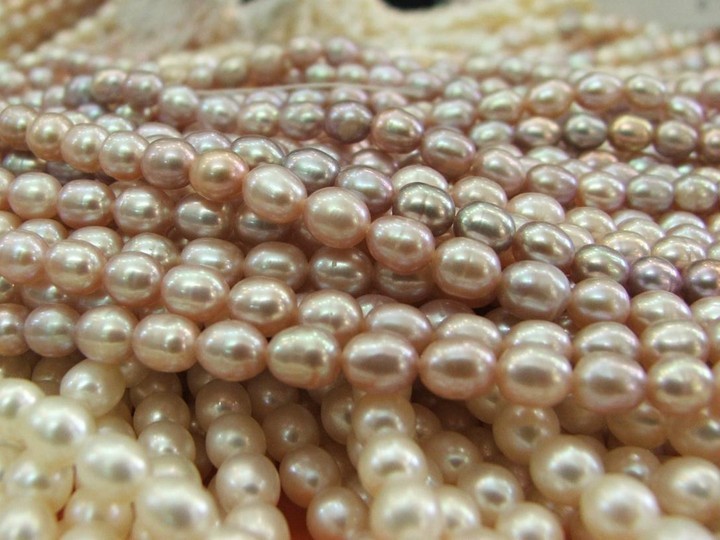
A working reference photograph is in place, captured from a freely-licensed Wikimedia Commons source (File:Laad_Bazaar_Pearls,_Charminar_(3306693856).jpg). Flickr-sourced image of Hyderabad's Laad Bazaar pearl trade, typically CC BY 2.0. Depicts the historic trading milieu rather than a certified natural pearl item; verify on the Commons page before use. Treat this as a placeholder for marketing purposes: exact licence terms should be re-verified on the Commons file page, and original producer photography is recommended before final trade use.