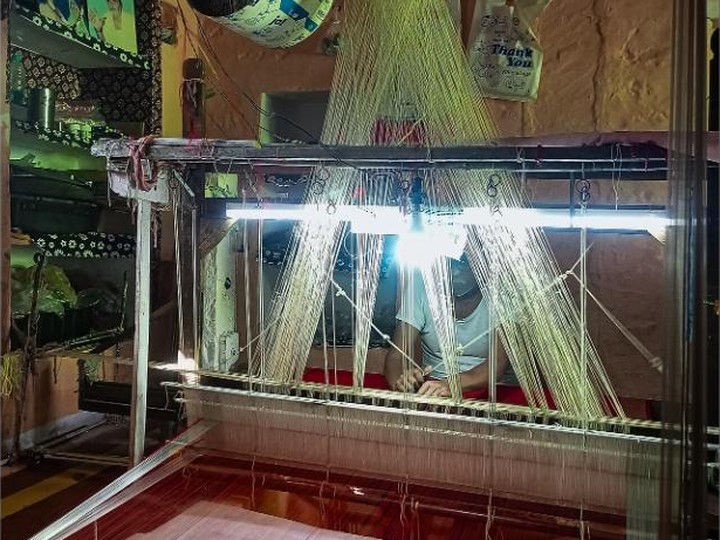
Bhujodi handwoven wool textile
Kutch's Vankar-weaver wool, loomed in the desert village that gave it its name.
| Origin | Kutch, Gujarat, India |
| Indian subcontinent | Yes |
| Category | Heritage Textiles & Weaves |
| Retail price band | mid |
| Bulk / trade price band | budget |
| Sourcing status | Dossier researched from public sources — producer contact not yet established |
| Compliance status | Preliminary review complete (see below) — not yet legally verified |
Detailed study
Bhujodi weaving uses pit looms and extra-weft (interlocking) techniques to produce sturdy, low-sheen wool cloth — shawls, stoles and blankets — in stripes, checks and geometric extra-weft motifs, historically woven from local sheep wool (kala/desi wool) for pastoral Rabari and Ahir communities' everyday and ceremonial use. Natural dyeing with madder, indigo and other plant/mineral dyes is traditionally paired with the weave, though synthetic dyes are now common for cost reasons.
Provenance & producer
The craft is centred on Bhujodi village, a few kilometres from Bhuj in the Kutch district of Gujarat, and is practised predominantly by the Vankar (weaver) community, most famously associated with master-weaver families such as the Vishram Valji lineage. Kutch's broader textile-craft ecosystem (weaving, embroidery, block-printing, tie-dye) has been supported since the 2001 earthquake by NGOs like Khamir and Shrujan, which helped rebuild and market Bhujodi weaving to national and export buyers.
Market & pricing
Bhujodi wool shawls and stoles sit in the accessible mid-market of Indian handloom — more affordable than silk-embroidery categories but positioned above machine-loomed wool goods, appealing to ethical-fashion and slow-textile retail buyers as well as Indian domestic gifting and export boutiques specializing in Gujarat handicrafts.
Compliance & export
There is a GI registration covering 'Kutch Shawls' held by regional weaver associations, so trade descriptions should reflect genuine Bhujodi/Kutch-woven origin rather than generic 'Kutch-style' machine-made substitutes. Wool goods exported from India need standard textile HS-code classification and country-of-origin marking; importing countries (EU, US, Australia) may require fibre-content labelling declaring wool percentage and blend.
Sources
Image status
A working reference photograph is in place, captured from a freely-licensed Wikimedia Commons source. Handloom weaving in progress on a traditional pit loom, Rishikachauhan1, CC BY-SA 4.0, via Wikimedia Commons. Note: illustrates generic Indian handloom weaving technique; not documented as photographed in Bhujodi, Kutch specifically as claimed for this listing. Treat this as a placeholder for marketing purposes: exact licence terms should be re-verified on the Commons file page, and original producer photography is recommended before final trade use.