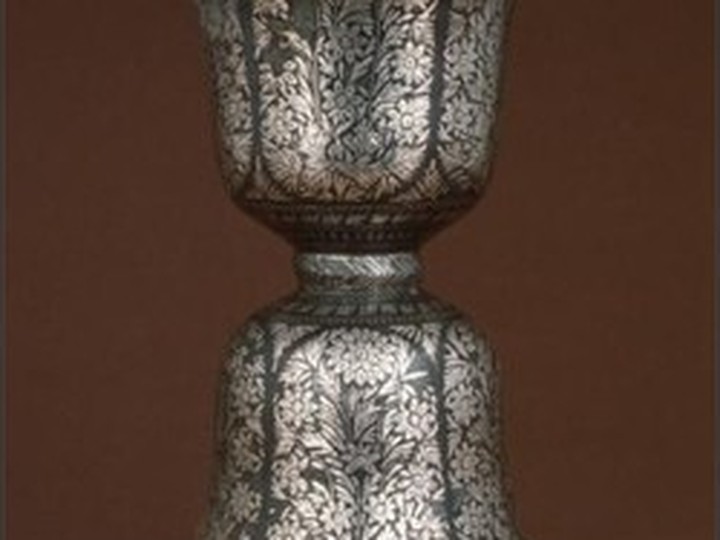
Bidriware inlaid metal decor (silver-on-blackened-alloy)
15th-century Deccan royal metalcraft — pure silver inlaid into a blackened zinc-copper alloy.
| Origin | Bidar, Karnataka, India |
| Indian subcontinent | Yes |
| Category | Gems, Metalwork & Craft |
| Retail price band | mid |
| Bulk / trade price band | budget-to-mid for smaller decor items |
| Sourcing status | Dossier researched from public sources — producer contact not yet established |
| Compliance status | Preliminary review complete (see below) — not yet legally verified |
Detailed study
Bidriware is made from a cast alloy of zinc and copper (occasionally with tin/lead), into which artisans hand-chisel designs and inlay pure silver (or occasionally gold) wire and sheet; the piece is then treated with a soil-and-ammonium-chloride paste unique to Bidar's earth that oxidizes the base metal to a deep matte black while leaving the silver untouched and bright.
Provenance & producer
Bidriware originated in Bidar, Karnataka (some accounts trace introduction to Persian metalworkers under the Bahmani Sultanate in the 14th-15th century) and remains concentrated among a small number of traditional karigar families in Bidar; it received Geographical Indication (GI) registration in India in 2006.
Market & pricing
Pieces range from small GI-tagged curios and jewellery boxes (budget-mid) to large decorative vases, hookah bases and museum-grade antiques (premium), sold through India's state emporia, GI-certified craft platforms, and export handicraft wholesalers; the craft is officially listed as endangered due to a shrinking artisan base.
Compliance & export
As a registered GI product, authentic pieces should carry GI certification/logo from the Bidriware GI registry to avoid mislabelled competing 'Bidri-style' goods made outside Bidar; since items contain sterling/pure silver inlay, export listings should disclose silver content and, where sold as fine metalware, comply with destination-country precious-metal labelling rules.
Sources
- Digital GI — Bidriware
- Village Square — Bidriware: A 15th Century Craft in Peril
- GiTAGGED — Bidriware GI-tagged products
Image status
A working reference photograph is in place, captured from a freely-licensed Wikimedia Commons source (File:Spittoon_(ugaldan)_a_Bidri_ware,_Hyderabad,_India.jpg). Museum-object photograph in Commons' Bidriware category. Verify licence on the Commons page before use. Treat this as a placeholder for marketing purposes: exact licence terms should be re-verified on the Commons file page, and original producer photography is recommended before final trade use.