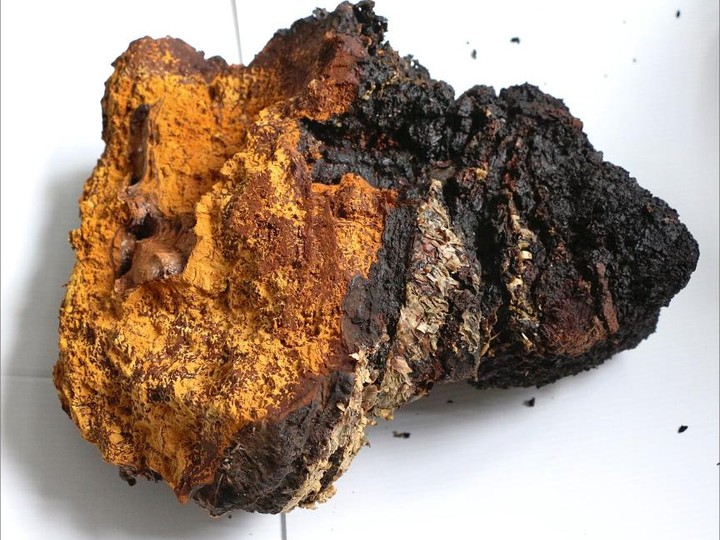
Canadian wild-harvested chaga oil infusion
Boreal-forest wild chaga, hand-harvested from Ontario birch and infused for skincare.
| Origin | Ontario, Canada |
| Indian subcontinent | No |
| Category | Global Fibers, Oils & Botanicals |
| Retail price band | $$$ (infused oil, indicative $40–90/L depending on carrier oil and chaga:oil ratio) |
| Bulk / trade price band | Bulk dried raw chaga chunks sold separately by the kilogram to processors; infused-oil pricing is typically per finished-product volume rather than bulk commodity rate |
| Sourcing status | Dossier researched from public sources — producer contact not yet established |
| Compliance status | Preliminary review complete (see below) — not yet legally verified |
Detailed study
Chaga (Inonotus obliquus) is a sterile conk — a hardened mass of mycelium, not a conventional mushroom fruiting body — that grows on living birch trunks in boreal forests; in Canada it is formally classified as 'sterile conk trunk rot of birch.' Harvested conks are dried and cold-infused/macerated into a carrier oil to extract lipid-soluble triterpenes and melanin-complex compounds, marketed mainly as a wellness and skincare ingredient.
Provenance & producer
Ontario's boreal birch forests support small-scale wild-harvest chaga operations typical of the wider Canadian chaga trade, which also spans Quebec and Manitoba. Because chaga is not commercially cultivated at scale, wild harvesting from standing birch trees remains the standard sourcing method for this category.
Market & pricing
Demand sits within the growing North American and global functional-mushroom and natural-skincare/wellness market, driven by 'adaptogen' positioning; buyers include supplement brands and natural cosmetics formulators. Supply is inherently constrained because chaga conks can take a decade or more to mature on a host tree, limiting sustainable harvest volumes.
Compliance & export
Chaga is not a CITES-listed or legally protected species, but sustainability is a genuine live concern: because harvest removes a slow-growing conk from its host tree, many Canadian foragers (including Indigenous harvesters) follow voluntary guidance to leave a portion of each conk to allow regrowth. Products marketed with health claims fall under Health Canada Natural Health Product rules; quality and potency vary significantly across suppliers due to inconsistent processing and labelling, so batch-level quality documentation is advisable for B2B buyers.
Sources
Image status
A working reference photograph is in place, captured from a freely-licensed Wikimedia Commons source. Chaga (Inonotus obliquus) conk, approx. 4.2 kg, harvested from a birch tree, JBouchez, CC BY-SA 4.0, via Wikimedia Commons Treat this as a placeholder for marketing purposes: exact licence terms should be re-verified on the Commons file page, and original producer photography is recommended before final trade use.