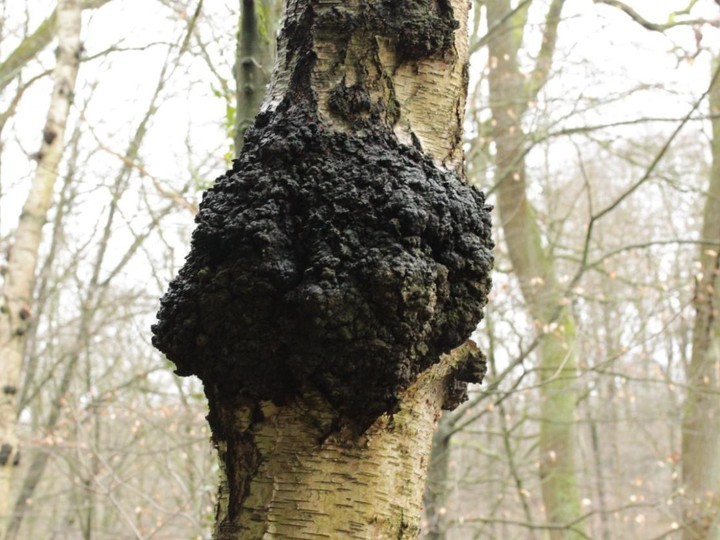
Chaga (Inonotus obliquus) from Himalayan birch stands
Chaga conk claimed from Himalayan birch stands in Kashmir/Himachal Pradesh — a botanically plausible but not yet independently confirmed origin; verify before marketing at scale.
| Origin | Unverified, flagged: no published mycological record of Inonotus obliquus (Chaga) fruiting on Himalayan birch (Betula utilis) in Kashmir or Himachal Pradesh was found, despite active searching. Betula utilis genuinely occurs in the Kashmir/HP subalpine zone (3,000–4,300m), and Chaga is a birch-obligate parasite found across the boreal/cold-temperate Northern Hemisphere, so the claim is biologically plausible but not confirmed by any source located. |
| Indian subcontinent | Yes |
| Category | Fungi & Functional Mycology |
| Retail price band | India-side retail/trade listings for chaga extract run ₹950–₹7,000/kg (IndiaMART); this reflects the general Indian chaga trade (likely repackaged imported material) rather than a confirmed Himalayan-wild-harvest premium. |
| Bulk / trade price band | Same IndiaMART band applies in bulk (drum-packed 1–50kg lots), ₹950–₹7,000/kg depending on grade; international wild-chaga wholesale (Nordic/Siberian) provides a stronger, better-documented benchmark for genuinely wild-harvested material. |
| Sourcing status | Dossier researched from public sources — producer contact not yet established |
| Compliance status | Preliminary review complete (see below) — not yet legally verified |
Detailed study
Inonotus obliquus is a parasitic/saprotrophic fungus that forms a hard, charcoal-like sclerotium ('conk') almost exclusively on living birch, in cold boreal and cold-temperate climates; it is prized for betulinic-acid-related triterpenes and melanin-derived pigments inherited from its birch host. It is harvested by cutting the sclerotium from the trunk without felling the tree.
Provenance & producer
No named collector, cooperative, or institutional harvesting structure specific to Kashmir/Himachal Pradesh chaga was found. Given the unresolved species-record question above, provenance claims for this specific product should be treated as unverified pending direct confirmation from the stated supply chain.
Market & pricing
Indian chaga extract trades ₹950–₹7,000/kg per IndiaMART listings, but these do not specify Himalayan wild origin versus imported/repackaged material — likely the latter, given the lack of confirmed Himalayan chaga literature. This is flagged as the clearest data gap among these products.
Compliance & export
Fungi are outside CITES scope. Wild collection from Himalayan forest areas in Kashmir/HP would be subject to state forest-produce permitting; birch (Betula utilis) itself is a slow-growing, ecologically sensitive high-altitude species and sustainable, non-destructive conk harvesting should be a stated practice and verified with the supplier.
Sources
- Inonotus obliquus — Wikipedia
- Therapeutic properties of Inonotus obliquus (Chaga mushroom): A review
- Chaga Mushroom Extract, ₹950/kg (IndiaMART, New Delhi)
- A Grade Brown Dry Chaga Mushroom, ₹7,000/kg (IndiaMART, Mumbai)
Image status
A working reference photograph is in place, captured from a freely-licensed Wikimedia Commons source (File:Chaga Mushroom - Inonotus obliquus (40358524662).jpg). Flickr-derived Commons upload, typically CC BY 2.0 — confirm on file page. Treat this as a placeholder for marketing purposes: exact licence terms should be re-verified on the Commons file page, and original producer photography is recommended before final trade use.