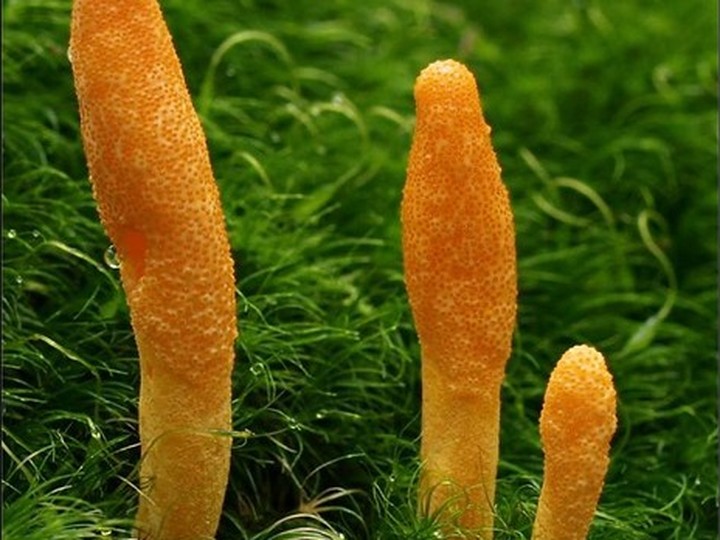
Cordyceps-infused adaptogenic tea blend
First/second-flush Darjeeling tea blended with cultivated Cordyceps militaris for an adaptogenic, high-elevation infusion.
| Origin | Darjeeling is a genuine, world-famous tea origin in West Bengal, so the tea-leaf component is credible. Cordyceps militaris is not native to or traditionally grown in Darjeeling; commercial Cordyceps militaris cultivation in India is documented at facilities like GUIDE (Gujarat Institute of Desert Ecology, Kutch) and various small growers, not in Darjeeling's tea gardens — treat the Cordyceps as a blended-in ingredient sourced elsewhere, not a Darjeeling-grown fungus. |
| Indian subcontinent | Yes |
| Category | Fungi & Functional Mycology |
| Retail price band | Retail: comparable Indian Cordyceps militaris tea/powder products list at roughly ₹120,000 per kg for the dried Cordyceps component alone (Indiamart listing, 2025), implying a small tea-blend sachet/tin with modest Cordyceps content would retail well above standard premium tea pricing, likely ₹500–₹2,000+ for a small format depending on Cordyceps proportion. |
| Bulk / trade price band | Bulk/trade: dried Cordyceps militaris tea quoted at ₹120,000/kg on Indiamart (2025) for the mushroom component; Darjeeling tea leaf itself trades at a wide range from ordinary garden tea to invitational-auction lots fetching lakhs per kg for rare first-flush lots — blend economics depend heavily on the Cordyceps:tea ratio, which was not independently verifiable for this specific product. |
| Sourcing status | Dossier researched from public sources — producer contact not yet established |
| Compliance status | Preliminary review complete (see below) — not yet legally verified |
Detailed study
Cordyceps militaris is a well-documented entomopathogenic fungus, distinct from wild Himalayan Ophiocordyceps sinensis, that is now commercially cultivated (rather than wild-harvested) using grain-substrate methods; it is studied for cordycepin and adenosine content and is a real, legitimate adaptogenic ingredient increasingly grown domestically in India.
Provenance & producer
Darjeeling's tea gardens supply globally recognised, GI-tagged black and green tea; the Cordyceps militaris used in blends of this kind is typically lab/facility-cultivated (Indian producers include operations in Gujarat and small Himalayan-region growers) rather than wild-collected in Darjeeling, since Cordyceps militaris cultivation requires controlled substrate conditions not part of tea-garden agriculture.
Market & pricing
Indiamart lists dried Cordyceps militaris tea at ₹120,000 per kg (2025); Darjeeling tea separately commands premium pricing at auction for top garden lots, so a genuine blend product sits at the high end of the specialty-tea category, priced primarily by its Cordyceps content.
Compliance & export
As a food blend, this falls under FSSAI's tea-blending and nutraceutical-labelling rules; Cordyceps militaris (unlike wild Ophiocordyceps sinensis) is not a CITES-listed or wildlife-protected species, so the main compliance requirement is standard FSSAI food-safety licensing and accurate, non-medicinal labelling of adaptogenic claims.
Sources
- Dried Cordyceps Militaris Tea pricing (Indiamart)
- Cordyceps Militaris cultivation at GUIDE, Gujarat (Krishi Jagran)
- Cordyceps militaris market research overview
Image status
A working reference photograph is in place, captured from a freely-licensed Wikimedia Commons source (File:2010-08-06 Cordyceps militaris 1.jpg). On Wikimedia Commons under the file's stated free licence — confirm exact CC tag on the file page before commercial use. Treat this as a placeholder for marketing purposes: exact licence terms should be re-verified on the Commons file page, and original producer photography is recommended before final trade use.