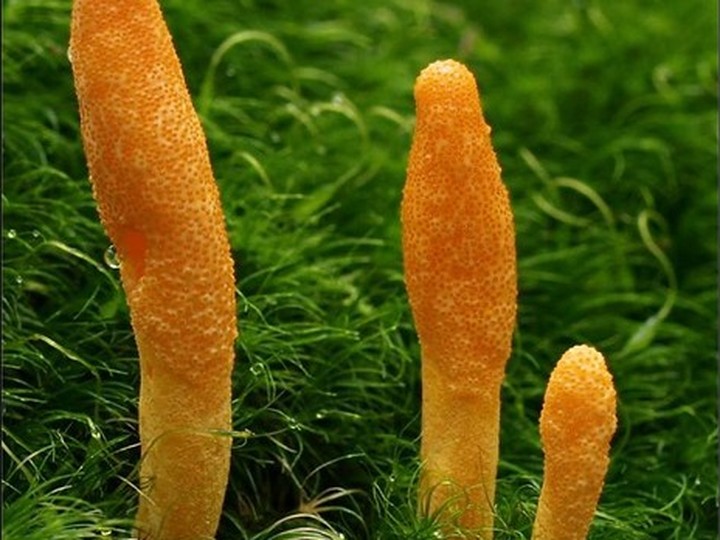
Cultivated Cordyceps militaris extract, dual-standardised
Tray-cultivated in Himalayan hill-station climate rooms and dual-standardised for cordycepin and adenosine — the scalable, traceable entry point into the cordyceps category.
| Origin | Himachal Pradesh, India |
| Indian subcontinent | Yes |
| Category | Fungi & Functional Mycology |
| Retail price band | Retail (premium packaged extract): approx. INR 70,000/kg equivalent |
| Bulk / trade price band | Trade/bulk (dried fruiting body): INR 24,000–30,000/kg (approx. USD 290–360/kg) |
| Sourcing status | Dossier researched from public sources — producer contact not yet established |
| Compliance status | Preliminary review complete (see below) — not yet legally verified |
Detailed study
Unlike wild Ophiocordyceps sinensis, Cordyceps militaris fruits readily in controlled cultivation on a rice- or grain-based substrate, typically reaching harvest in 45–60 days. It is naturally rich in cordycepin and adenosine, the two compounds most associated with its functional claims; "dual-standardised" extracts are tested by HPLC for both. Cultivation removes the extreme scarcity and altitude-collection constraints of wild caterpillar fungus, at the cost of the wild-provenance story that drives C. sinensis pricing.
Provenance & producer
Small hill-station cultivation units have emerged in Himachal Pradesh (Shimla and Kullu districts) and in Uttarakhand (Dehradun), growing in semi-controlled climate rooms rather than in open forest. Because the product is cultivated, provenance verification is a facility audit and batch-testing question (farm visit, HPLC certificate of analysis) rather than a wild-collection chain-of-custody question — a materially simpler diligence path than for wild fungi.
Market & pricing
Retail packaged extract in the Indian market lists at roughly INR 70,000/kg equivalent (extrapolated from a 50g pack at INR 3,500). Wholesale dried fruiting body trades far lower, at INR 24,000–30,000/kg — the retail/wholesale spread is wide and is explained by direct-to-consumer packaging, testing and brand positioning rather than raw material scarcity.
Compliance & export
As a cultivated crop, this product sits outside the Biological Diversity Act's wild-access provisions. It is regulated as a food/nutraceutical ingredient: export requires standard FSSAI documentation on the India side, and, on the destination side, compliance with novel-food or dietary-supplement rules — Cordyceps militaris is not a traditionally consumed food in the EU, so EU Novel Food regulation is a live consideration; the US and UK treat it as a dietary supplement ingredient with corresponding labelling requirements.
Sources
- My Pahadi Dukan — Himalayan-foraged/cultivated Cordyceps militaris pricing
- ICAR — economic potential of Cordyceps mushroom cultivation
- Principal Scientific Adviser to GoI — Cordyceps militaris commercial cultivation technology
Image status
A working reference photograph is in place, captured from a freely-licensed Wikimedia Commons source (File:2010-08-06 Cordyceps militaris 1.jpg). Wikimedia Commons candidate — licence to be re-verified before use; not yet downloaded into this site (see build note). Treat this as a placeholder for marketing purposes: exact licence terms should be re-verified on the Commons file page, and original producer photography is recommended before final trade use.