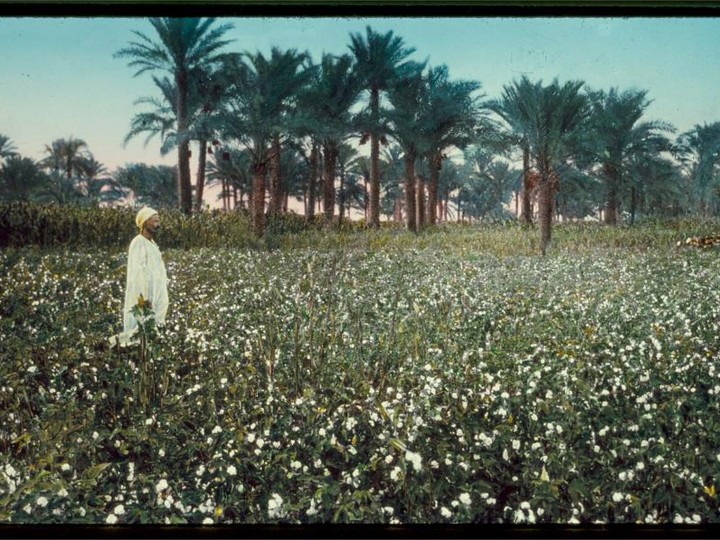
Egyptian extra-long-staple cotton textile
True extra-long-staple Gossypium barbadense — the fibre real Egyptian cotton claims are made of.
| Origin | Nile Delta, Egypt |
| Indian subcontinent | No |
| Category | Heritage Textiles & Weaves |
| Retail price band | premium |
| Bulk / trade price band | mid |
| Sourcing status | Dossier researched from public sources — producer contact not yet established |
| Compliance status | Preliminary review complete (see below) — not yet legally verified |
Detailed study
Egyptian cotton refers to varieties of Gossypium barbadense grown in Egypt, prized for extra-long-staple (ELS) fibres of 1⅜ inch (35mm) or longer, which allow spinning into very fine, strong, smooth yarns ideal for high-thread-count bedding, fine shirting and luxury toweling. Commercial cultivation dates to 1820 when a French engineer, Louis Alexis Jumel, recognised the potential of cotton growing ornamentally in Cairo; subsequent hybridisation with Sea Island cotton produced classic cultivars like Ashmouni and Mit Afifi.
Provenance & producer
Production is concentrated in the Nile Delta and Nile Valley, where controlled irrigation historically expanded rapidly in the late 19th century, partly spurred by demand created when the American Civil War disrupted US cotton supply. Genuine Egyptian-grown ELS cotton is now a comparatively small share of global cotton production, which increases both its premium positioning and its exposure to mislabelling.
Market & pricing
Authentic Egyptian ELS cotton commands premium-to-luxury pricing versus standard upland cotton and is targeted at fine bedding, shirting and toweling brands, hospitality/hotel linen buyers and premium home-textile retailers; because of the name's cachet, it is one of the most frequently counterfeited fibre-origin claims in home textiles.
Compliance & export
Egyptian cotton has been the subject of major mislabelling scandals in the US and UK (well-publicised lawsuits against bedding retailers for selling non-Egyptian cotton as 'Egyptian cotton'), so authenticity documentation matters commercially and legally: buyers should look for licensing from the Cotton Egypt Association, which administers an official 'Egyptian Cotton' logo/trademark programme to verify genuine Egypt-grown fibre through the supply chain. In the US, FTC textile-labelling rules prohibit false fibre-origin claims; in the EU/UK, Regulation (EU) No 1007/2011 and equivalent UK rules require accurate fibre-content and, where claimed, truthful origin labelling.
Sources
Image status
A working reference photograph is in place, captured from a freely-licensed Wikimedia Commons source. Egypt. Agriculture. An Egyptian cotton field, G. Eric and Edith Matson Photograph Collection, Library of Congress, public domain, via Wikimedia Commons. Treat this as a placeholder for marketing purposes: exact licence terms should be re-verified on the Commons file page, and original producer photography is recommended before final trade use.