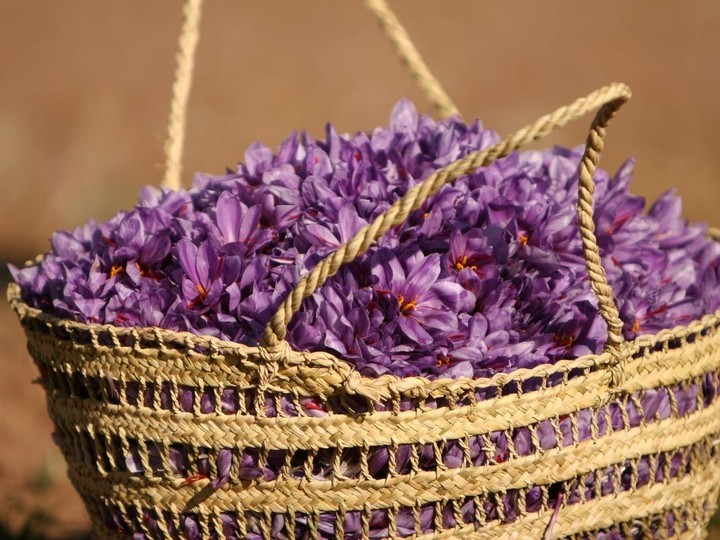
Iranian saffron, super negin grade
Hand-picked at dawn from Crocus sativus fields on the Khorasan plateau and dried within hours, Super Negin's long, unbroken all-red stigmas deliver among the highest coloring strength of any saffron grade.
| Origin | Khorasan, Iran |
| Indian subcontinent | No |
| Category | Rare Spices, Botanicals & Teas |
| Retail price band | Retail roughly USD 8-15 per gram depending on vendor and current market |
| Bulk / trade price band | FOB bulk export approx. USD 1,295-1,550 per kg for Super Negin grade (Sunland Saffron bulk listing) |
| Sourcing status | Dossier researched from public sources — producer contact not yet established |
| Compliance status | Preliminary review complete (see below) — not yet legally verified |
Detailed study
Saffron is the hand-harvested stigma of Crocus sativus; 'Negin' and 'Super Negin' are Iranian trade grades denoting the longest, thickest, most uniform all-red stigma threads with no yellow/white style attached and minimal crumbling — the top of Iran's ISIRI 259-based grading hierarchy (above Sargol, Pushal and Bunch grades). Super Negin is defined by very high coloring strength (crocin, measured as absorbance around 240-290+ units), plus high safranal (aroma) and picrocrocin (bitterness) content.
Provenance & producer
Iran produces roughly 90% of the world's saffron, and Khorasan Province (particularly South/Razavi Khorasan around Ghaenat, Torbat-e Heydarieh and Qaen) is by far the dominant growing region due to its cold winters, hot dry summers and low rainfall ideal for corm dormancy. Harvesting is intensely labour-intensive smallholder work — flowers are picked by hand before sunrise and stigmas separated the same day, then dried, largely through family farms and local cooperatives before entering export channels.
Market & pricing
Bulk export FOB pricing for Super Negin runs roughly USD 1,295-1,550/kg per current trade listings (Sunland Saffron), while retail gram pricing is tracked by dedicated saffron-price sites reflecting persistent volatility tied to Iranian rial exchange rates, sanctions-driven trade friction, and harvest size.
Compliance & export
Saffron has no DOP/PGI protection specific to Iranian origin (unlike Spain's DOP 'Azafrán de La Mancha'), so 'Khorasan saffron' is a geographic descriptor rather than a protected legal designation. US/EU import of Iranian-origin goods is subject to sanctions-related restrictions on Iranian trade (OFAC rules in the US restrict most Iran-origin commercial imports; the EU applies its own Iran sanctions regime with some humanitarian/food carve-outs), so buyers must verify current sanctions status and supply-chain documentation — importers commonly source Iranian-origin saffron via re-export through UAE or EU intermediaries, and re-export/relabeling requires accurate country-of-origin declaration to avoid customs violations.
Sources
- Sunland Saffron – Bulk Super Negin Saffron
- Saffronwell – Saffron Price 2026 Guide
- Wikipedia – Saffron trade
Image status
A working reference photograph is in place, captured from a freely-licensed Wikimedia Commons source (File:860808-Saffronfarm-06-IMG 7879-2.jpg). Filename bears a Persian (Solar Hijri) date stamp and 'Saffronfarm' label suggesting an Iranian saffron-farm photo; confirm licence and exact provenance on the file page. Alternative fallback: File:Crocus sativus - Saffron crocus - Safran 03.JPG, a clearly identified Crocus sativus flower/stigma image. Treat this as a placeholder for marketing purposes: exact licence terms should be re-verified on the Commons file page, and original producer photography is recommended before final trade use.