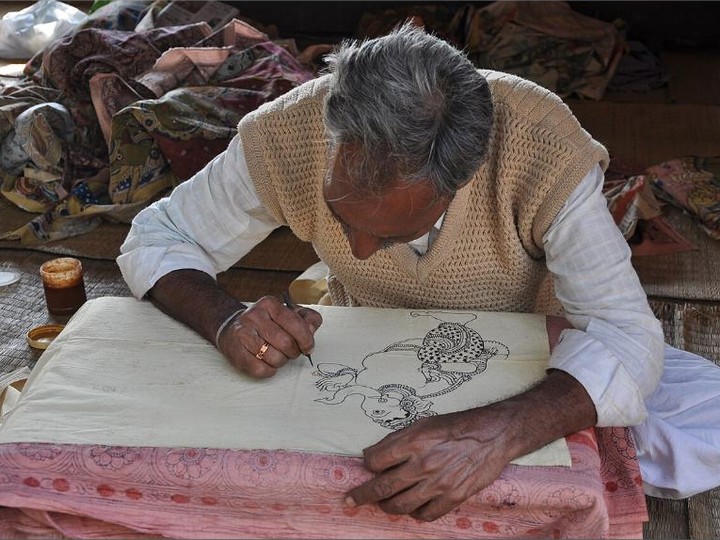
Kalamkari hand-painted cotton textile
Mythology drawn in vegetable dye, one bamboo pen stroke at a time.
| Origin | Srikalahasti, Andhra Pradesh, India |
| Indian subcontinent | Yes |
| Category | Heritage Textiles & Weaves |
| Retail price band | mid |
| Bulk / trade price band | budget |
| Sourcing status | Dossier researched from public sources — producer contact not yet established |
| Compliance status | Preliminary review complete (see below) — not yet legally verified |
Detailed study
Srikalahasti Kalamkari is a hand-painted (not block-printed) technique, using a bamboo/date-palm-stick pen (kalam) dipped in natural dyes drawn from flowers, roots, minerals and fermented ingredients like myrobalan and jaggery. The full process runs roughly 17 steps including cloth treatment (in buffalo milk and myrobalan), multiple mordanting and dyeing stages, and sun-drying, and is distinct from the block-printed Machilipatnam style also called Kalamkari.
Provenance & producer
The craft is rooted in Srikalahasti, Tirupati district, Andhra Pradesh, historically patronized by temples during the Vijayanagara Empire for depicting Hindu religious narratives on temple hangings and scrolls. It carries a GI registration (filed by the artisan body KARUNA) that specifically protects the Srikalahasti hand-painted style.
Market & pricing
Srikalahasti Kalamkari occupies the mid-tier of India's hand-craft textile market — priced above printed 'kalamkari-look' fabric but below fully hand-embroidered or brocaded textiles — and appeals to home-decor, wall-art, and apparel buyers seeking authentic hand-painted narrative art; export demand is growing through state economic development board initiatives.
Compliance & export
Buyers should confirm whether a piece is genuinely hand-painted (Srikalahasti) versus block-printed (Machilipatnam) since both are marketed under 'Kalamkari' but only the hand-painted Srikalahasti style carries this specific GI; natural-dye claims should be substantiated, as synthetic-dye imitations are common and subject to different chemical/textile safety labeling requirements (e.g. AZO dye restrictions) for EU and US import.
Sources
Image status
A working reference photograph is in place, captured from a freely-licensed Wikimedia Commons source. Kalamkari painting, an artisan hand-painting a kalamkari motif with a traditional kalam pen, Anilbhardwajnoida, CC BY-SA 3.0, via Wikimedia Commons. Treat this as a placeholder for marketing purposes: exact licence terms should be re-verified on the Commons file page, and original producer photography is recommended before final trade use.