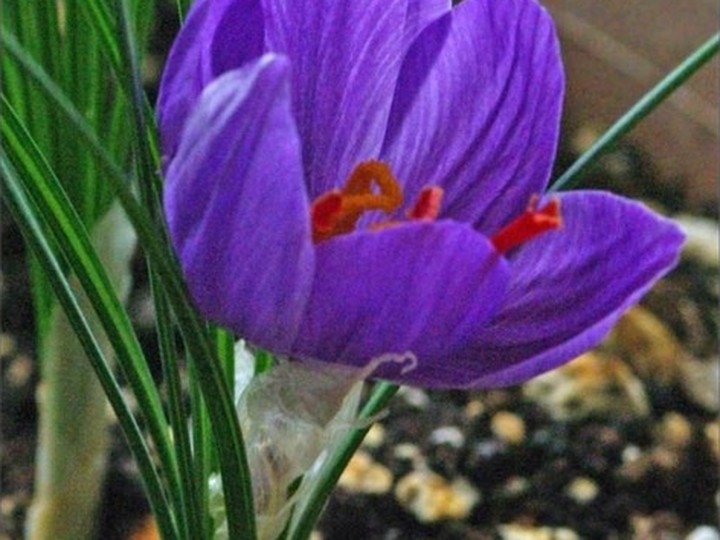
Kashmir Mongra saffron (GI-tagged)
Hand-picked from Crocus sativus corms grown on the Karewa plateaus around Pampore, Kashmir's Mongra grade delivers the deepest crimson threads and highest crocin content of any Indian saffron.
| Origin | Pampore, Kashmir, India |
| Indian subcontinent | Yes |
| Category | Rare Spices, Botanicals & Teas |
| Retail price band | Retail: approx. Rs 300–455 per gram (Rs 300,000–455,000/kg) for certified GI-tagged Mongra grade, per current online Kashmiri saffron retailers |
| Bulk / trade price band | Bulk/trade: approx. Rs 150,000–170,000/kg on IndiaMART wholesale listings for Mongra-grade Pampore saffron |
| Sourcing status | Dossier researched from public sources — producer contact not yet established |
| Compliance status | Preliminary review complete (see below) — not yet legally verified |
Detailed study
Kashmir saffron comes from Crocus sativus, a triploid, sterile species propagated only by corm division, grown almost exclusively on the Karewa (loess) plateaus of the Kashmir Valley. Mongra is the highest of the traditional trade grades — hand-separated pure stigma threads with no yellow style attached — prized for crocin (colour), picrocrocin (bitterness) and safranal (aroma) levels that lab testing shows exceed Iranian and Spanish saffron on average. Grading markers include thread colour depth, length, and absence of broken/floral debris.
Provenance & producer
Cultivation is concentrated in Pampore, Pulwama, Budgam and Srigufwara-Kokernag in the Kashmir Valley, largely by smallholder families on karewa land, often coordinated through the Saffron Producers' cooperative structures supported by the National Saffron Mission and Pampore's Saffron Trading Centre/Park.
Market & pricing
Kashmir saffron carries a substantial premium over Iranian saffron in Indian retail (commonly 3-5x), reflecting low national output (roughly 15-20 tonnes/year against Iran's several hundred), labour-intensive hand-harvesting (over 150,000 flowers per kg), and GI-protected branding; IndiaMART and specialist retailers list Mongra at the price points above.
Compliance & export
Kashmir saffron received India's GI tag in 2020 (Craft Development Institute, Srinagar as registered proprietor) and is further protected by mandatory ISO 3632 lab certification (colour/crocin testing) administered via the Pampore Saffron Park before sale under the GI mark. Export requires Spices Board India registration; destination markets such as the EU and US apply standard food-safety/labelling rules for spices (no novel-food restriction applies to saffron).
Sources
- IndiaMART — Mogra Saffron, Pampore
- Kashmir Online Store — GI-Tagged Kashmiri Mongra Saffron
- GI Tag Product Export Guide 2026 (Darjeeling, Saffron, Bhujia)
Image status
A working reference photograph is in place, captured from a freely-licensed Wikimedia Commons source (File:Crocus sativus - Saffron crocus - Safran 01.JPG). Genuine photograph of Crocus sativus (the correct species) but not identifiably shot in Kashmir — no Pampore-specific, freely-licensed Commons photo was found. Use with a caption noting it is a representative Crocus sativus image, not a Kashmir-location photo, or commission an original. Treat this as a placeholder for marketing purposes: exact licence terms should be re-verified on the Commons file page, and original producer photography is recommended before final trade use.