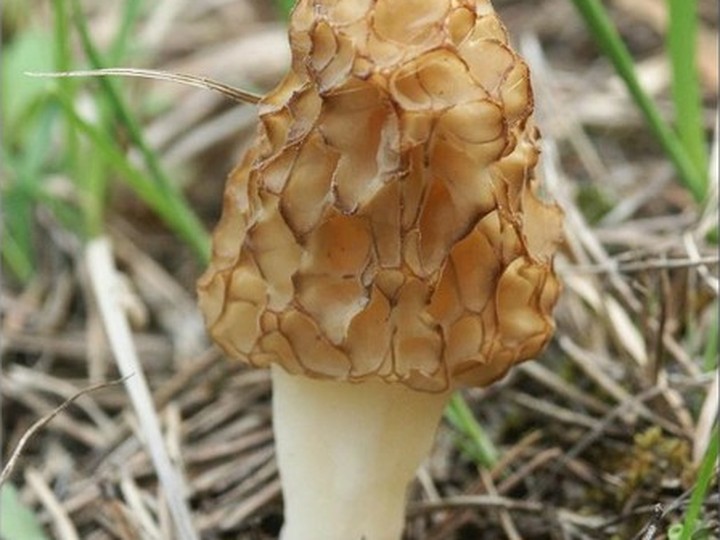
Kashmir morel (Morchella esculenta), spring wild harvest
Kashmir Valley guchhi is a spring wild-harvested true morel (Morchella esculenta group) gathered from Himalayan conifer and orchard floors after snowmelt, among the most expensive edible fungi in the world.
| Origin | Kashmir Valley, India |
| Indian subcontinent | Yes |
| Category | Fungi & Functional Mycology |
| Retail price band | Indian specialty sellers list Kashmiri A-grade dried morels around ₹18,500/kg (Indiamart), with consumer press citing ₹30,000-40,000/kg for top-grade wild dried guchhi (India.com, Forbes India). |
| Bulk / trade price band | Village-level dried collection in the wider Himalayan belt reported around ₹8,000/kg at first-purchase (Himachal comparator, Tribune India), with margins building through consolidator, grading and export stages. |
| Sourcing status | Dossier researched from public sources — producer contact not yet established |
| Compliance status | Preliminary review complete (see below) — not yet legally verified |
Detailed study
Morchella esculenta (the 'true morel'/guchhi) is a spring-fruiting ascomycete associated with disturbed ground and orchard/forest floor litter; it cannot be commercially cultivated outdoors at scale in the Himalaya, so all Kashmiri supply is wild-foraged over a short window. Yields are climate-sensitive — unusually warm or dry springs measurably reduce harvests.
Provenance & producer
Harvest is done by local villagers and foragers across Kashmir Valley forest floors and orchard margins during the brief March-May fruiting window, then sun/shade-dried and sold through local aggregators and traders. Buyers should ask for lot-level district/village provenance since Himalayan morel trade is often aggregated across multiple valleys before sale.
Market & pricing
Indian trade listings show A-grade Kashmiri morels priced near ₹18,500/kg wholesale, while retail/consumer coverage cites premium dried guchhi reaching ₹30,000-40,000/kg — reflecting its status as one of the world's priciest wild mushrooms.
Compliance & export
Morchella species are not CITES-listed. Collection falls under India's general forest-produce and biodiversity-access rules (Biological Diversity Act / state forest regulations governing minor forest produce); export requires standard food-safety/phytosanitary documentation. As a long-traditional food species it does not require EU Novel Food authorisation.
Sources
- IndiaMART – A Grade Kashmiri Morel Mushrooms, Srinagar
- India.com – This Rare Indian Mushroom Costs Rs 30,000 Per Kg
- Forbes India – Chasing wild mushrooms that cost Rs 40,000 per kg
- dialogue.earth – Morels: Climate change hits harvest
Image status
A working reference photograph is in place, captured from a freely-licensed Wikimedia Commons source (File:Morchella_esculenta_300405.jpg). Hosted in the Morchella esculenta Commons category; check the file page for exact CC licence/attribution terms before use. Treat this as a placeholder for marketing purposes: exact licence terms should be re-verified on the Commons file page, and original producer photography is recommended before final trade use.