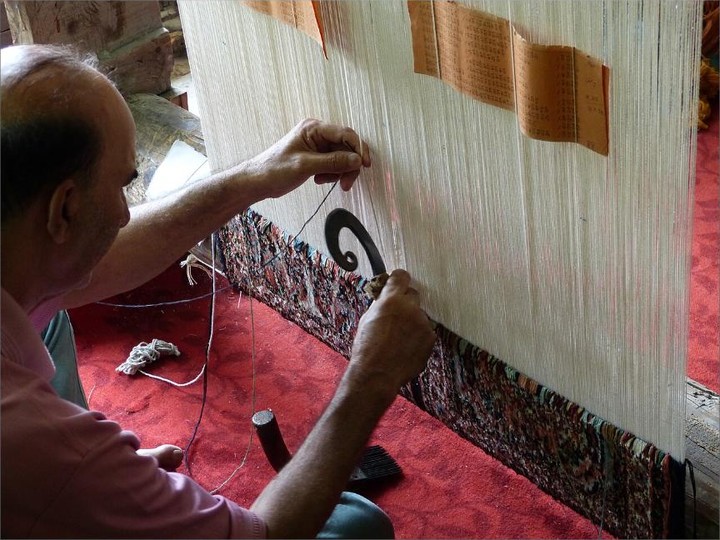
Kashmiri hand-knotted silk carpet
Knot by knot, Srinagar's master weavers turn silk into heirloom carpets.
| Origin | Srinagar, Kashmir, India |
| Indian subcontinent | Yes |
| Category | Heritage Textiles & Weaves |
| Retail price band | luxury |
| Bulk / trade price band | premium |
| Sourcing status | Dossier researched from public sources — producer contact not yet established |
| Compliance status | Preliminary review complete (see below) — not yet legally verified |
Detailed study
Kashmiri carpets are entirely hand-knotted (not tufted or machine-woven) using the Persian senneh/asymmetric knot, with silk-pile carpets reaching extremely high knot densities (commonly 300-900+ knots per square inch for fine pieces), making them among the most labour-intensive carpets in the world — a single fine silk carpet can take a weaver a year or more to complete.
Provenance & producer
The craft is centred on Srinagar and the Kashmir valley, introduced via Persian-Central Asian influence historically linked to the 14th-15th century reign of Sultan Zain-ul-Abidin, who is credited with bringing master weavers to Kashmir. 'Kashmir Carpet' holds a registered GI tag (with a dedicated GI authentication logo introduced to combat counterfeit machine-made 'Kashmir-style' carpets from other regions).
Market & pricing
Genuine hand-knotted silk Kashmir carpets sit firmly in the luxury tier, targeting high-end interior design, collectors, and export buyers in the US, Europe and Gulf markets; the market has historically been undermined by carpets falsely labeled 'Kashmiri silk' that are actually machine-made or woven with mercerized cotton ('art silk') rather than mulberry silk.
Compliance & export
GI-authenticated carpets should carry the official Kashmir GI logo/certificate distinguishing hand-knotted silk from art-silk or machine-made imitations; export requires accurate fibre-content declaration (real silk vs. mercerized cotton) since misdescription is a common fraud risk, and large wool/silk carpet shipments are subject to standard customs HS-code classification with no CITES restriction, as mulberry silk (Bombyx mori) is a farmed, non-endangered species.
Sources
- Mondaq - GI Tag Conferred On Kashmiri Carpet
- Kashmir Observer - GI Registry Assigns New Logo To Kashmir Carpet
Image status
A working reference photograph is in place, captured from a freely-licensed Wikimedia Commons source. Photograph of a craftsman hand-knotting a traditional Kashmiri silk carpet on a loom, Zatara-Iqbal, CC BY-SA 4.0, via Wikimedia Commons. Treat this as a placeholder for marketing purposes: exact licence terms should be re-verified on the Commons file page, and original producer photography is recommended before final trade use.