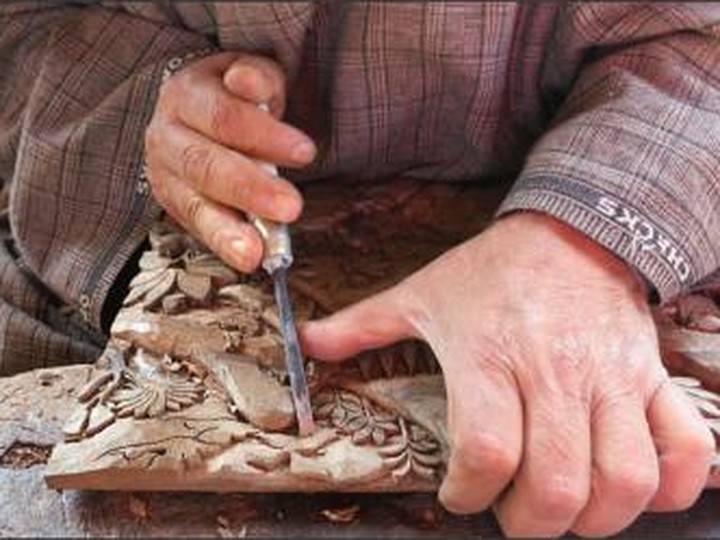
Kashmiri walnut wood hand-carved decor
Carved from the heartwood of Kashmir's own walnut trees — a Himalayan craft tradition over 500 years old.
| Origin | Srinagar, Kashmir, India |
| Indian subcontinent | Yes |
| Category | Gems, Metalwork & Craft |
| Retail price band | mid |
| Bulk / trade price band | budget-to-mid depending on grading (heartwood/deep-carve vs. sapwood/shallow-carve) |
| Sourcing status | Dossier researched from public sources — producer contact not yet established |
| Compliance status | Preliminary review complete (see below) — not yet legally verified |
Detailed study
Kashmiri walnut wood carving uses the dense, fine-grained heartwood of Juglans regia (walnut) trees grown in the Kashmir valley, hand-carved in styles ranging from deep/undercut relief to shallow and semi-carving, in motifs of chinar leaves, vines, lotus and Mughal floral patterns; quality is graded by which part of the log is used (heartwood carving fetches the highest value, sapwood the lowest).
Provenance & producer
The craft is centred in Srinagar and surrounding Kashmir valley towns, with roots often traced to Central Asian/Persian woodcarving influences introduced during the 14th-15th century Sultanate period alongside other Kashmiri crafts like papier-mâché and khatamband; Kashmir Walnut Wood Carving received Geographical Indication (GI) registration in 2021 (with a commemorative postal cover issued the same year).
Market & pricing
Products span mid-range decorative boxes, trays and furniture panels to premium fully hand-carved heartwood furniture pieces, sold through Kashmir's state emporia (e.g., J&K Handicrafts), GI-certified export platforms, and increasingly niche international interior-design and antique-reproduction buyers; sustained walnut tree depletion has made heartwood-grade pieces scarcer and more valuable.
Compliance & export
GI-registered pieces should carry certification confirming Kashmir-valley sourcing and the wood-grade classification (heartwood vs. sapwood) since this materially affects value and is a known area of mis-selling; because walnut logging intersects with local forestry regulation, export shipments should carry documentation of legal timber sourcing, and larger furniture items may require phytosanitary/fumigation certificates for international wood-product import rules.
Sources
- Wikipedia — Kashmir walnut wood carving
- Incredible India — Kashmir Walnut Wood Carving
- Greater Kashmir — Eight More Kashmir Crafts Earn GI Tag
Image status
A working reference photograph is in place, captured from a freely-licensed Wikimedia Commons source. Kashmiri walnut wood handicrafts, artisan hand-carving a floral walnut wood panel, credited to gaatha.com, CC BY-SA 4.0, via Wikimedia Commons. Treat this as a placeholder for marketing purposes: exact licence terms should be re-verified on the Commons file page, and original producer photography is recommended before final trade use.