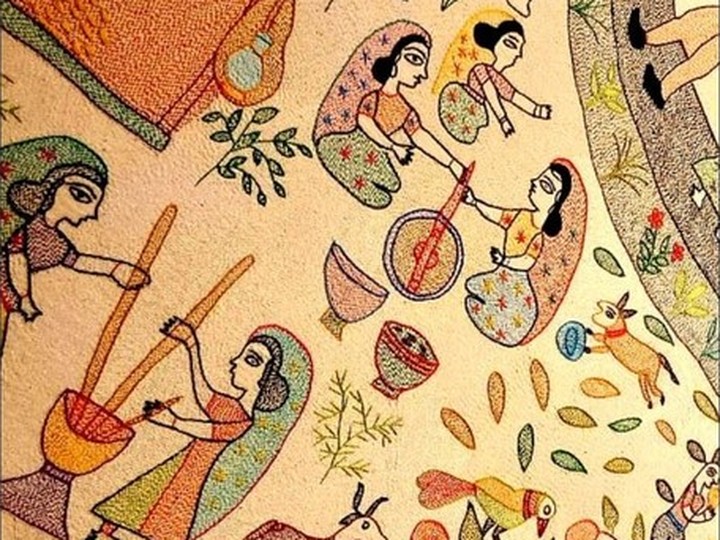
Madhubani hand-painted artwork on handmade paper
Living folk-line art from the birthplace of Sita, painted by Mithila's women artists
| Origin | Mithila region, Bihar, India |
| Indian subcontinent | Yes |
| Category | Art & Heritage Objects |
| Retail price band | mid |
| Bulk / trade price band | budget (wholesale/tourist-grade small formats) |
| Sourcing status | Dossier researched from public sources — producer contact not yet established |
| Compliance status | Preliminary review complete (see below) — not yet legally verified |
Detailed study
Madhubani (Mithila) painting is a line-and-fill folk art traditionally made with natural pigments (turmeric, sindoor, charcoal, plant dyes) and bamboo-twig or nib pens on handmade paper, cloth, or walls, characterized by double-line borders, geometric fill patterns, and iconography of Hindu deities, flora, fauna, and social/ritual scenes. Five recognized sub-styles exist — Bharni, Kachni, Tantrik, Godna, and Kohbar — each tied to a caste or ritual tradition within the Mithila community.
Provenance & producer
The art form originates in the Mithila cultural region centered on Madhubani district, Bihar (extending into the Terai of neighbouring Nepal), traditionally practiced by women for domestic wall and floor decoration during festivals and weddings before its 1960s transition to paper and commercial sale after a severe regional drought. 'Madhubani painting' / 'Mithila painting' holds a Geographical Indication (GI) tag registered in India, protecting the name for work produced by artisans in the designated Bihar districts.
Market & pricing
Madhubani paintings range from low-cost tourist/souvenir pieces to museum-quality works by National Award-winning artists (e.g. Padma Shri recipients like Baua Devi, Sita Devi lineage, Bharti Dayal) that sell for hundreds to several thousand dollars; the mid-market for genuine hand-painted, artist-signed works on handmade paper is well established in Indian and diaspora gift/decor retail and growing in Western ethnic-art and interior-design channels. Target buyers include heritage-decor retailers, gallery/collector buyers, and gifting/export B2B channels.
Compliance & export
Products sold under the 'Madhubani' or 'Mithila' name should be traceable to GI-registered artisan clusters to avoid GI-Act misrepresentation; export requires standard Indian handicraft export documentation (IEC code, GST invoicing) and, for pieces claiming natural-pigment/heritage authenticity, artisan attribution or certificate of authenticity is recommended given the prevalence of factory-printed imitations sold as 'Madhubani style.' No wildlife/CITES material is typically involved, but any pieces using natural dyes derived from restricted plant/animal sources should be checked.
Sources
Image status
A working reference photograph is in place, captured from a freely-licensed Wikimedia Commons source (File:Colorful Madhubani painting.jpg). Verify exact CC-BY/CC-BY-SA tag on the Commons file page before use. Treat this as a placeholder for marketing purposes: exact licence terms should be re-verified on the Commons file page, and original producer photography is recommended before final trade use.