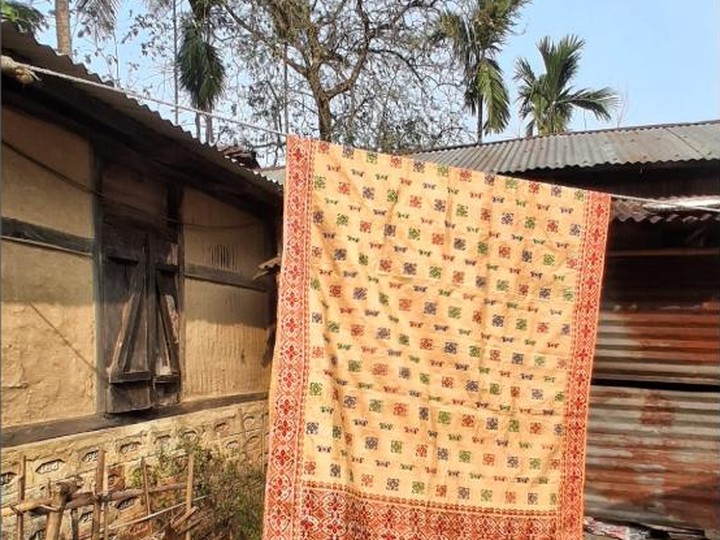
Muga silk stole, natural golden sheen (Assam-exclusive)
Assam's living gold — silk that grows more lustrous with every wash.
| Origin | Sualkuchi, Assam, India |
| Indian subcontinent | Yes |
| Category | Heritage Textiles & Weaves |
| Retail price band | premium |
| Bulk / trade price band | mid |
| Sourcing status | Dossier researched from public sources — producer contact not yet established |
| Compliance status | Preliminary review complete (see below) — not yet legally verified |
Detailed study
Muga silk is reeled from the cocoons of the semi-domesticated Antheraea assamensis moth, whose larvae feed on aromatic som and sualu leaves. Unlike other silks it is never fully bleached, retaining its natural golden-yellow sheen, and is exceptionally durable, actually gaining lustre with repeated washing rather than degrading.
Provenance & producer
Muga is unique to Assam, with Sualkuchi (on the Brahmaputra, near Guwahati) as its historic weaving hub, established as a royal weaving settlement in the 11th century under King Dharma Pala. It received Geographical Indication status in 2007 (GI logo 2014), administered with support from the Central Silk Board, and is exclusively produced by traditional Assamese sericulture and weaving communities.
Market & pricing
As the rarest of India's silks (annual production only around 100-150 tonnes), muga sits in the premium tier, sold as stoles, mekhela chadors and sari fabric to heritage-conscious domestic buyers and a growing export niche in sustainable/slow-fashion markets; wholesale buyers should expect significant price variance between pure hand-reeled muga and cheaper muga-blend or eri-mixed goods.
Compliance & export
Genuine muga products should carry Silk Mark/Central Silk Board certification and the muga GI label to distinguish them from tussar or mulberry silk sold under the muga name; export shipments of silk textiles fall under standard HS heading declarations and Indian handloom export incentive schemes, with no CITES or wildlife restriction since Antheraea assamensis is farmed, not wild-harvested from a protected species.
Sources
Image status
A working reference photograph is in place, captured from a freely-licensed Wikimedia Commons source. An authentic Assam Muga silk textile, Papori Bora, CC BY-SA 4.0, via Wikimedia Commons Treat this as a placeholder for marketing purposes: exact licence terms should be re-verified on the Commons file page, and original producer photography is recommended before final trade use.