Mysore sandalwood oil, government-certified
Steam-distilled from mature Santalum album heartwood grown in Karnataka's government-controlled sandal tracts, prized worldwide for its rich santalol content and centuries-old KSDL provenance.
| Origin | Karnataka, India |
| Indian subcontinent | Yes |
| Category | Rare Spices, Botanicals & Teas |
| Retail price band | Retail ₹3,500–₹9,000 for 10ml (roughly ₹350,000–₹900,000/kg) depending on santalol grade and vendor; Karnataka Soaps & Detergents Ltd (KSDL) 5ml/10ml bottles are the reference government-certified benchmark though KSDL does not publish online prices directly (per KSDL/KSTDC listings) |
| Bulk / trade price band | Wholesale/bulk East Indian sandalwood oil trades broadly in the range of ₹1.5–4 lakh/kg (roughly USD 1,800–4,800/kg) depending on santalol purity and supply-year scarcity, per trade and industry-report sources |
| Sourcing status | Dossier researched from public sources — producer contact not yet established |
| Compliance status | Preliminary review complete (see below) — not yet legally verified |
Detailed study
Mysore sandalwood oil is steam-distilled from the heartwood of mature (typically 15–30 year old) Santalum album trees, valued for its high alpha- and beta-santalol content (traditionally graded above 90% combined santalol under ISO 3518), which gives it a persistent, creamy-woody note used in perfumery, incense and Ayurveda. Quality grading looks at santalol percentage, specific gravity, optical rotation and absence of adulteration with synthetic or Australian/Santalum spicatum-derived oil. Genuine Mysore-region oil commands a premium over sandalwood grown elsewhere in India or overseas because of the tree's slow growth and the historic reputation of Karnataka-processed oil.
Provenance & producer
Santalum album is a hemi-parasitic tree native to the Deccan plateau, historically concentrated in Karnataka (Mysuru, Kolar, Chikmagaluru) and parts of Tamil Nadu and Andhra Pradesh; because the species was a Karnataka state government monopoly for decades, harvesting and processing were tightly controlled through the state forest department and government-owned Karnataka Soaps and Detergents Ltd (KSDL), which still runs the historic distillery. Since Karnataka amended the Karnataka Forest Act to permit private cultivation (private ownership was legalized starting 2001-02), farmer-grown sandalwood has grown alongside state forest supply, but the state government retains regulatory oversight, felling permits and revenue-sharing requirements. KSDL and Karnataka State Handicrafts/KSTDC remain the primary 'government-certified' processing and retail channels.
Market & pricing
Genuine Mysore sandalwood oil retails from roughly ₹3,500 upward for a 10ml bottle at government-linked and specialty retailers, and industry pricing/trade reports place bulk East Indian sandalwood oil in the low-to-mid lakhs of rupees per kg given persistent supply scarcity versus demand from perfumery and pharma; the IMARC sandalwood oil market report and Kannauj attar-industry press coverage both describe an acute, worsening supply shortage driving prices up over the past decade.
Compliance & export
Santalum album is not currently CITES-listed (unlike agarwood/Aquilaria or red sanders, Pterocarpus santalinus, which are CITES Appendix II and DGFT export-restricted respectively) — but felling, transport and sale of sandalwood within India remain regulated under state forest laws (notably the Karnataka Forest Act and Karnataka Sandalwood Rules), requiring transit permits even for privately grown trees. Export of sandalwood oil from India is permitted under DGFT policy subject to documentation confirming legal sourcing, and government-manufactured oil (KSDL) typically carries state-certification marks distinguishing it from unregulated private production; buyers in the EU/US should note IFRA fragrance-use restrictions apply to any santalol-heavy essential oil used in cosmetic blends.
Sources
- Karnataka Soaps and Detergents Limited (Wikipedia)
- House of Mysore Sandal (KSDL official site)
- IMARC Sandalwood Oil Market Report
- Past, present and future of Indian sandalwood cultivation (Springer)
- Export Policy of Sandalwood (DGFT notification)
Image status
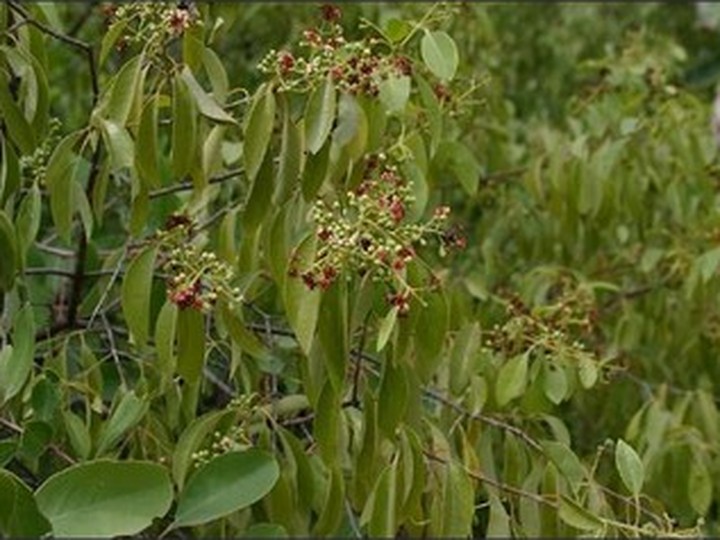
A working reference photograph is in place, captured from a freely-licensed Wikimedia Commons source (File:Santalum album (Chandan) in Hyderabad, AP W IMG 0025.jpg). Correctly identified Santalum album tree, but photographed in Hyderabad (Andhra Pradesh/Telangana), not Karnataka — usable as a botanically accurate species reference image with a caption noting it is not a Mysore-specific photo; no Commons image found that is confirmed to depict a Mysuru/Karnataka sandal tract specifically. Standard Commons licensing (check file page for exact CC-BY/CC-BY-SA terms) applies. Treat this as a placeholder for marketing purposes: exact licence terms should be re-verified on the Commons file page, and original producer photography is recommended before final trade use.