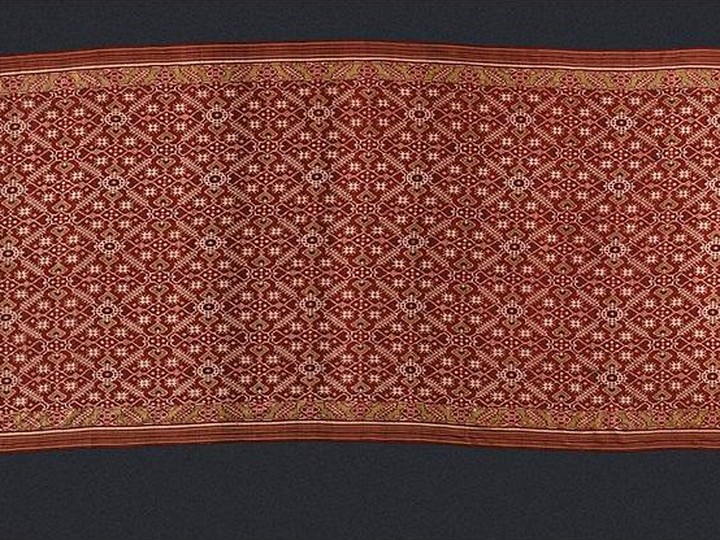
Patan Patola double-ikat silk sari
One thread, both directions, zero margin for error — Patan's 850-year-old double ikat.
| Origin | Patan, Gujarat, India |
| Indian subcontinent | Yes |
| Category | Heritage Textiles & Weaves |
| Retail price band | luxury |
| Bulk / trade price band | luxury |
| Sourcing status | Dossier researched from public sources — producer contact not yet established |
| Compliance status | Preliminary review complete (see below) — not yet legally verified |
Detailed study
Patan Patola is true double ikat: both the warp and weft silk threads are individually tie-dye resisted according to a pre-calculated pattern before weaving, so the design must align perfectly on both axes as the cloth is woven — a technical feat achieved by very few weaving traditions worldwide. A single sari can take anywhere from several months to over a year to complete, depending on pattern complexity.
Provenance & producer
The craft is practised by the Salvi weaving community in Patan, Gujarat, whose weaving lineage is documented to over 850 years, with some historians linking the technique's origins to motifs seen in the 4th-century Ajanta cave paintings; legend credits Raja Kumarpal with summoning Salvi weavers to Patan for royal patronage. Only a handful of Salvi families continue the authentic double-ikat practice today.
Market & pricing
Patan Patola is one of the most expensive handloom textiles in the world, with authentic silk double-ikat saris typically priced from roughly ₹2 lakh (~US$2,400) into the several-lakh range, positioning it firmly for ultra-high-net-worth retail, museum/collector acquisition, and premium bridal/heirloom export rather than volume trade.
Compliance & export
Because 'Patola' as a term is also used for cheaper single-ikat imitations from Rajkot and printed 'Patola-look' fabric, genuine Patan double-ikat pieces should be sold with documented provenance (ideally from a recognized Salvi workshop) and, where applicable, GI certification specific to Patan Patola; export of high-value silk goods should include accurate valuation documentation for customs given the exceptionally high per-piece value.
Sources
Image status
A working reference photograph is in place, captured from a freely-licensed Wikimedia Commons source. Woman's Wedding Sari, silk plain weave with warp- and weft-resist dye (patola) and gold metallic thread supplementary weft, India, Gujarat, Patan, 19th century, LACMA Costume Council Fund (M.71.37.2), public domain, via Wikimedia Commons. Treat this as a placeholder for marketing purposes: exact licence terms should be re-verified on the Commons file page, and original producer photography is recommended before final trade use.