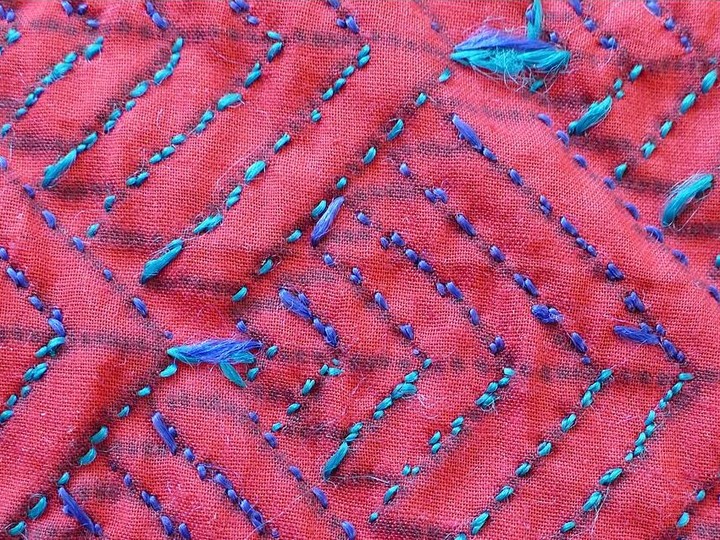
Phulkari hand-embroidered textile
Punjab's folk-embroidery legacy, stitched thread by thread in silken darn-work.
| Origin | Punjab, India |
| Indian subcontinent | Yes |
| Category | Heritage Textiles & Weaves |
| Retail price band | premium |
| Bulk / trade price band | mid |
| Sourcing status | Dossier researched from public sources — producer contact not yet established |
| Compliance status | Preliminary review complete (see below) — not yet legally verified |
Detailed study
Phulkari (literally 'flower work') is built entirely from the darn stitch worked from the reverse of hand-spun cotton khaddar, so that the embroiderer never sees the front of the design until it is finished. Untwisted floss silk called 'patt' (historically sourced from Kashmir, Bengal, Afghanistan and China) is used in long and short stitches to build dense geometric and floral fields, with red and its shades traditionally dominant for their ritual significance among Punjabi Hindus and Sikhs. Fully covered pieces are called 'bagh' ('garden'); partially worked pieces retain the 'phulkari' name.
Provenance & producer
The craft is rooted in the Punjab region of the Indian subcontinent, with references in Punjabi folklore and 18th-century literature such as Waris Shah's Heer Ranjha, and a parallel tradition called 'gulkari' in Sindh. It nearly died out by the mid-20th century after Partition disrupted artisan communities and was revived through cooperative and heritage-craft programmes. Phulkari received Geographical Indication (GI) registration in India in 2011, with the protected zone covering Punjab, Haryana and Rajasthan producer clusters (Patiala, Amritsar, Jalandhar and surrounding districts).
Market & pricing
Genuine hand-embroidered vintage and new-make phulkari/bagh pieces occupy a premium heirloom-textile niche, priced well above the mass-produced machine-embroidered dupattas that dominate Indian bazaars; collectors and interior/fashion buyers in Europe, the US and the Gulf drive export demand. Retail buyers seek statement dupattas, shawls and wall panels; wholesale/export buyers include boutique fashion houses and home-decor curators who require documented hand-work versus machine imitation.
Compliance & export
Because 'Phulkari' is a registered GI in India, using the name for goods not made by authorized producers within the notified districts can be a legal misdescription; export listings should distinguish genuine hand-worked GI-eligible pieces from machine-embroidered 'phulkari-style' goods. Textile exports from India require standard customs documentation (invoice, HS code under embroidered textile headings, and country-of-origin declaration); destination markets like the EU and US require fiber-content labelling (cotton base, silk or viscose embroidery thread) under their respective textile labelling laws.
Sources
Image status
A working reference photograph is in place, captured from a freely-licensed Wikimedia Commons source. Embroidery on a shawl from Punjab, close-up detail of phulkari darn-stitch embroidery, Kritzolina, CC BY-SA 4.0, via Wikimedia Commons. Treat this as a placeholder for marketing purposes: exact licence terms should be re-verified on the Commons file page, and original producer photography is recommended before final trade use.