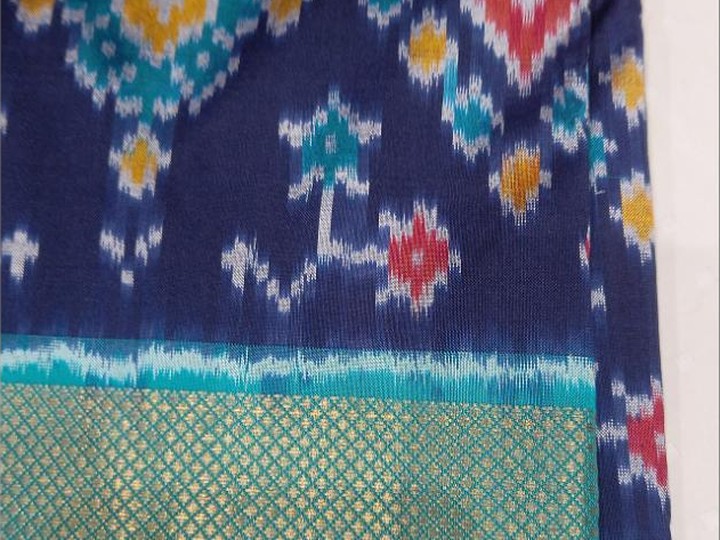
Pochampally Ikat silk textile, single/double ikat
Geometry born of thread — Telangana's double-ikat tradition, tied and dyed by hand.
| Origin | Bhoodan Pochampally, Telangana, India |
| Indian subcontinent | Yes |
| Category | Heritage Textiles & Weaves |
| Retail price band | mid |
| Bulk / trade price band | budget |
| Sourcing status | Dossier researched from public sources — producer contact not yet established |
| Compliance status | Preliminary review complete (see below) — not yet legally verified |
Detailed study
Pochampally Ikat (locally 'Paagadu Bandhu') uses resist tie-dyeing on warp and/or weft yarns before weaving, so the geometric pattern is pre-planned into the thread itself rather than printed or embroidered afterward; true double ikat (both warp and weft resist-dyed) is the most technically demanding and prestigious form, alongside simpler single-ikat and combination 'sico' (silk-cotton) pieces.
Provenance & producer
The craft is centred on Bhoodan Pochampally and roughly 100 surrounding villages in Yadadri Bhuvanagiri district, Telangana, with over 10,000 weaving families and 5,000+ looms active. It received GI protection in 2005, registered to the Pochampally Handloom Weavers Cooperative Society and the Pochampally Handloom Tie and Dye Silk Sarees Manufacturers Association, and the village is on UNESCO's tentative World Heritage list and was named a UN 'Best Tourism Village.'
Market & pricing
Pochampally Ikat spans budget cotton pieces to premium pure-silk double-ikat saris, giving it a wide addressable market from mass retail to export-grade collector pieces; annual cluster turnover exceeds ₹100 crore (~US$12M) in yarn and finished-goods trade, making it one of India's more commercially scaled handloom clusters.
Compliance & export
GI-tagged goods should reference the registered Pochampally proprietors' bodies; export labeling must distinguish pure silk, sico (silk-cotton blend) and cotton ikat since price and duty treatment differ by fibre content, and buyers should be aware that power-loom imitations of the ikat pattern (printed rather than resist-dyed) are common in the lower market and are not eligible for the GI mark.
Sources
Image status
A working reference photograph is in place, captured from a freely-licensed Wikimedia Commons source. Pochampalli Ikat saree, folded fabric showing double-ikat diamond motifs, made in Bhoodan Pochampally, Yadadri Bhuvanagiri district, Telangana, Ramkumar Kalyani, CC BY-SA 4.0, via Wikimedia Commons. Treat this as a placeholder for marketing purposes: exact licence terms should be re-verified on the Commons file page, and original producer photography is recommended before final trade use.