Provence lavender absolute, steam-distilled
Grown above 800m on the sun-baked plateaus of Haute-Provence and processed the same day as harvest, true lavender from this AOP-protected terroir yields an oil prized by perfumers for its soft, non-camphorous sweetness.
| Origin | Name/process mismatch: 'absolute' and 'steam-distilled' are contradictory — true absolutes are produced by solvent extraction of the concrete, not steam distillation (which yields essential oil). Recommend renaming to either 'Provence lavender essential oil, steam-distilled' (AOP Haute-Provence) or 'Provence lavender absolute, solvent-extracted'. Origin itself (Provence/Haute-Provence, France) is plausible and correct for true lavender (Lavandula angustifolia, distinct from lavandin). |
| Indian subcontinent | No |
| Category | Rare Spices, Botanicals & Teas |
| Retail price band | Retail lavender absolute roughly USD/EUR 15-40 per 5ml vial at specialty aromatics suppliers (Eden Botanicals, Hermitage Oils) |
| Bulk / trade price band | Wholesale lavender absolute approx. EUR 900/kg ex-VAT (Hermitage Oils, French concrete-derived); AOP-certified steam-distilled essential oil trades at a premium versus non-AOP/lavandin oil due to lower yields |
| Sourcing status | Dossier researched from public sources — producer contact not yet established |
| Compliance status | Preliminary review complete (see below) — not yet legally verified |
Detailed study
True lavender (Lavandula angustifolia) grown at altitude produces an essential oil markedly different from lavandin (a lower-altitude hybrid) — softer, less camphorous, and commanding a much higher price because yields are far lower. Two distinct commercial materials exist: the AOP-certified steam-distilled essential oil, and a solvent-extracted 'absolute' (produced via a hexane-extracted concrete, then alcohol-washed), used mainly in fine perfumery for its deeper, more tenacious floral-herbaceous profile that steam distillation cannot capture.
Provenance & producer
The Appellation d'Origine Protégée 'Huile essentielle de lavande de Haute-Provence' (AOP since 1981/EU-recognized 2019) restricts the name to wild-species lavender grown above roughly 800m in a defined zone spanning Alpes-de-Haute-Provence, Drôme, Vaucluse and part of Hautes-Alpes — towns such as Sault and Valensole are emblematic growing areas. Harvested lavender is typically distilled within hours in mobile or village stills to preserve top-note freshness; production is organized through grower cooperatives and the AOP syndicate that certifies each batch.
Market & pricing
French lavender essential oil prices show steady premiums for population/wild lavender over lavandin; solvent-extracted absolute is a niche, higher-value material priced around EUR 900/kg wholesale (Hermitage Oils) versus far lower per-kg rates for lavandin oil, reflecting lavender's much lower distillation yield (roughly 3-5 kg oil per tonne of flowers).
Compliance & export
AOP-labelled Haute-Provence lavender essential oil is a legally protected EU geographical indication; using the 'Provence' or 'Haute-Provence' name for oil not certified by the AOP syndicate risks mislabelling under French/EU GI law. For US/EU import, lavender oil/absolute is regulated as a cosmetic/fragrance ingredient (IFRA usage limits apply, especially for absolutes due to residual solvent traces and furocoumarin-type sensitisation profiles) rather than a food, so cosmetic-safety documentation (IFRA certificate, allergen declaration under EU Cosmetics Regulation) is required for compliant sale.
Sources
- Lavender Museum Luberon – What Guarantees Does the AOP Label Provide?
- Hermitage Oils – Lavender Absolute (French)
- AromaWeb – Lavender, Lavandin and Spike Lavender Essential Oil Guide
Image status
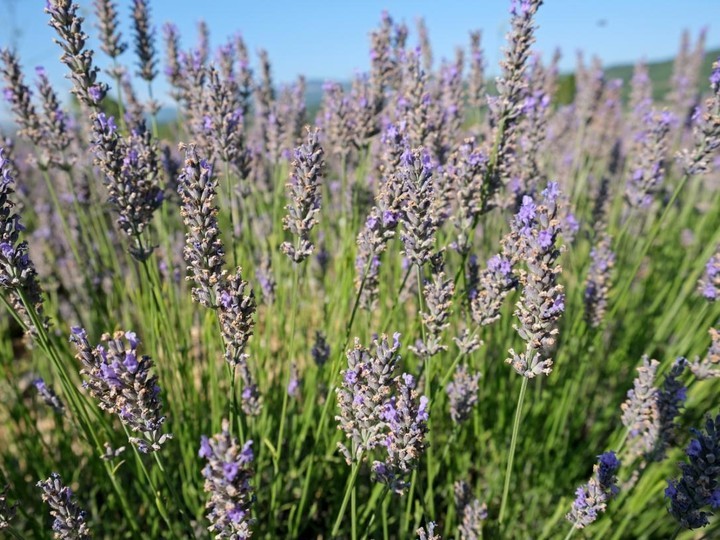
A working reference photograph is in place, captured from a freely-licensed Wikimedia Commons source (File:Sault lavender fields 2.jpg). Depicts lavender fields at Sault, a genuine AOP Haute-Provence lavender-growing commune; confirm licence terms on the file page before use. A field photo illustrates the crop but not the distillation/absolute-extraction process itself. Treat this as a placeholder for marketing purposes: exact licence terms should be re-verified on the Commons file page, and original producer photography is recommended before final trade use.