Rwandan single-origin specialty coffee
Bright, floral Bourbon-variety Arabica from the misty hills fringing Africa's oldest rainforest.
| Origin | Nyungwe Forest itself is a protected national park/rainforest reserve (gorilla/chimp habitat) and is not planted with coffee. Genuine coffee production is in the highland districts bordering the park — Nyamagabe, Nyaruguru, Huye and Nyamasheke — at roughly 1,500–2,000 m. Catalogue copy should read 'the highlands bordering Nyungwe Forest' rather than 'Nyungwe' as a growing origin. |
| Indian subcontinent | No |
| Category | Global Rare Foods & Ingredients |
| Retail price band | $$$ ($9–$16 per lb green; $22–$34 per lb roasted retail) |
| Bulk / trade price band | Container (18–19 MT) FOB Kigali: indicative $4,200–$6,800/MT for washed specialty-grade green, subject to season/cup score |
| Sourcing status | Dossier researched from public sources — producer contact not yet established |
| Compliance status | Preliminary review complete (see below) — not yet legally verified |
Detailed study
Rwanda grows almost exclusively Bourbon-derived Arabica (Coffea arabica), fully washed and sun-dried on raised beds, producing a clean, sweet cup with red-fruit and citrus notes. Rwanda's coffee sector was rebuilt from near-collapse after 1994 into a specialty-focused industry through donor-funded washing-station investment in the 2000s.
Provenance & producer
Cherries are grown by smallholders on volcanic, high-altitude soils in Rwanda's Congo-Nile Divide and southwestern highlands, then processed at community washing stations bordering Nyungwe National Park's buffer zone. Lots are typically fully washed, with growing volumes of natural and honey-processed micro-lots for the specialty market.
Market & pricing
Rwanda exports roughly 20,000–24,000 MT of green coffee annually, split between commercial and a growing specialty segment sold via direct-trade relationships to North American, European and Japanese roasters; the National Agricultural Export Development Board (NAEB) coordinates Cup of Excellence auctions that have raised international visibility.
Compliance & export
Export requires NAEB grading/certification and phytosanitary clearance; many washing stations hold Rainforest Alliance, Fair Trade, or organic certification. No CITES or GI protection applies to coffee; buyers should verify ICO Certificate of Origin and, where claimed, third-party sustainability certificates.
Sources
- Wikipedia — Nyungwe Forest National Park
- National Agricultural Export Development Board (NAEB), Rwanda — Coffee
Image status
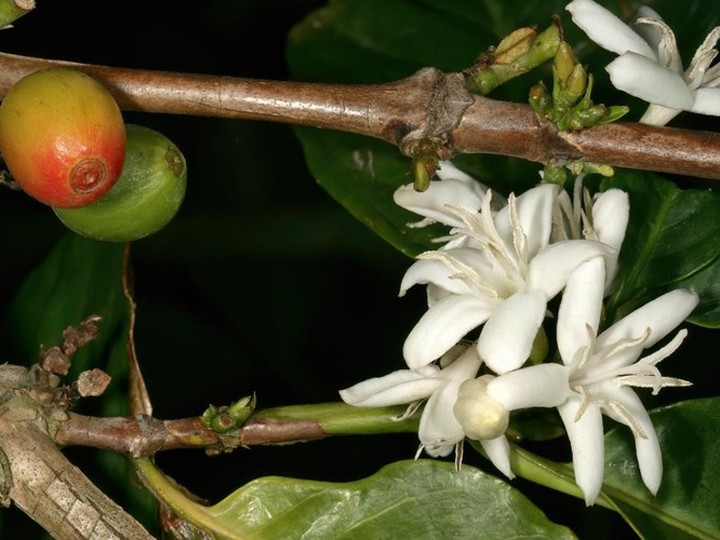
A working reference photograph is in place, captured from a freely-licensed Wikimedia Commons source (File:Coffea arabica - Köhler–s Medizinal-Pflanzen-020.jpg). Coffea arabica flowers and fruit, coffee farm near Port Edward, KwaZulu-Natal, SAplants, CC BY-SA 4.0, via Wikimedia Commons Treat this as a placeholder for marketing purposes: exact licence terms should be re-verified on the Commons file page, and original producer photography is recommended before final trade use.