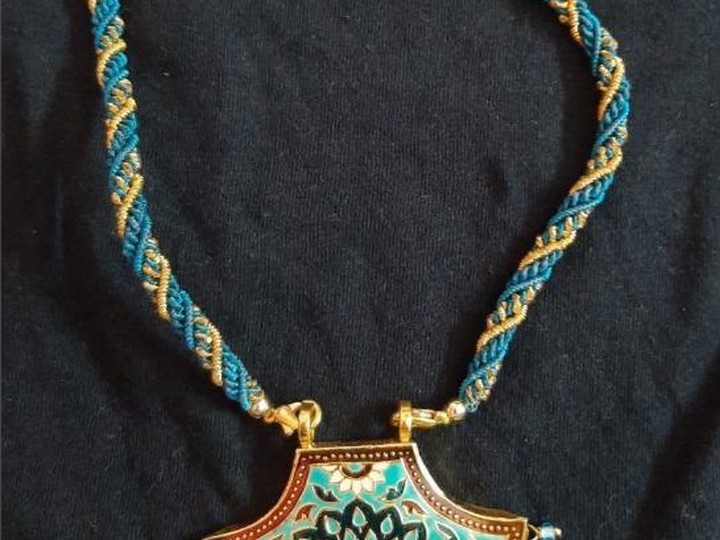
Thewa gold-on-glass jewellery art
A 300-year-old family secret — 23k gold sheet fused onto molten coloured glass, unique to one Pratapgarh clan.
| Origin | Pratapgarh, Rajasthan, India |
| Indian subcontinent | Yes |
| Category | Gems, Metalwork & Craft |
| Retail price band | premium |
| Bulk / trade price band | premium (low-volume, artisan-limited supply) |
| Sourcing status | Dossier researched from public sources — producer contact not yet established |
| Compliance status | Preliminary review complete (see below) — not yet legally verified |
Detailed study
Thewa is a highly specialised technique of fusing intricately engraved 23-karat gold sheet onto vividly coloured molten glass, creating jewellery and decorative panels with a jewel-like, almost enamel-like glow; the process — designing, engraving, and glass-fusing — is a closely guarded craft historically kept within a single artisan lineage, the Raj Soni family of Pratapgarh.
Provenance & producer
Thewa originated and remains almost exclusively practised in Pratapgarh, Rajasthan, with its invention traditionally dated to the early 18th century (c. 1707) and credited to Nathu ji Soni of the Raj Soni family under the patronage of the local Maharawat; Thewa Art Work holds Geographical Indication (GI) registration.
Market & pricing
Because it remains concentrated among a small number of Raj Soni family artisans in Pratapgarh, Thewa is a low-volume, premium-to-luxury craft — finished jewellery (pendants, earrings, brooches) commands prices reflecting both gold content and rarity of skilled labour, sold through GI-certified craft platforms, heritage jewellery boutiques, and increasingly showcased at national/international jewellery trade fairs (e.g., IIJS Bharat).
Compliance & export
As GI-registered goods, authentic Thewa pieces should be accompanied by GI certification identifying Pratapgarh-based, family-lineage artisan production to distinguish them from imitation 'gold-on-glass' work made elsewhere; gold content requires BIS hallmarking for domestic sale, and export documentation should specify gold purity (23k) and glass composition, since the glass base means pieces require fragile-goods handling/customs declarations distinct from solid-metal jewellery.
Sources
- Digital GI — Thewa Art: Rajasthan's Golden Craft
- Skyjems — Pratapgarh Thewa: Engraved Gold Sheet Fused to Coloured Glass
- GJEPC Solitaire — GI-Tagged Jewellery at IIJS Bharat Tritiya
Image status
A working reference photograph is in place, captured from a freely-licensed Wikimedia Commons source. Rajasthani Thewa Technique Pendant, gold-on-glass enamel jewellery art, SpeakingArch, CC BY-SA 4.0, via Wikimedia Commons. Treat this as a placeholder for marketing purposes: exact licence terms should be re-verified on the Commons file page, and original producer photography is recommended before final trade use.