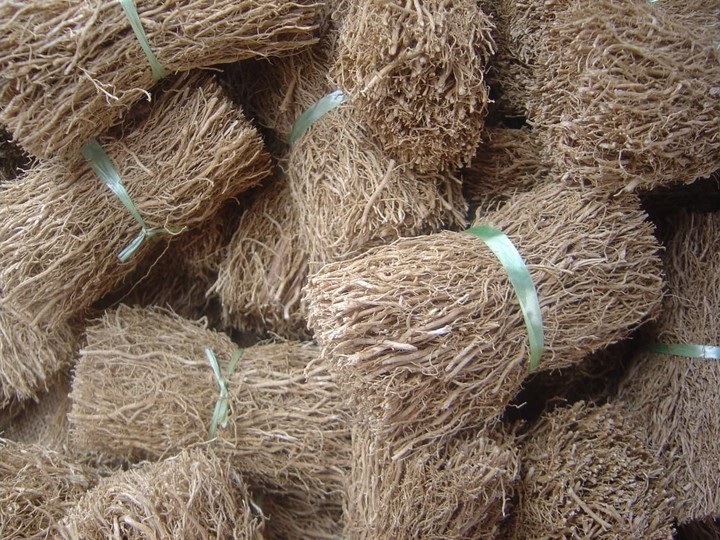
Vetiver (khus) root essential oil
Root-distilled from Chrysopogon zizanioides grass grown across Tamil Nadu's dryland tracts and Kannauj's historic 'ruh khus' distilleries, prized for its deep, earthy base note used in perfumery and traditional cooling remedies.
| Origin | Primarily Uttar Pradesh (Kannauj/Barabanki belt, for the classic 'ruh khus' distillation) and Tamil Nadu (India's largest vetiver-growing and oil-producing state, e.g. Coimbatore/Tirunelveli/Ramanathapuram belt); Rajasthan is not a significant vetiver-producing region — sourcing research (ICAR/CIMAP and vetiver.org literature) attributes major cultivation to Tamil Nadu, Karnataka (coastal belt), Uttar Pradesh and parts of North India, not Rajasthan. |
| Indian subcontinent | Yes |
| Category | Rare Spices, Botanicals & Teas |
| Retail price band | Retail ₹500–₹1,500 for 10–15ml bottles at specialty essential-oil retailers; bulk listings on IndiaMART show vetiver oil priced roughly ₹28,000–₹55,000 per kg depending on grade and origin |
| Bulk / trade price band | Bulk trade listings (IndiaMART) range approximately ₹28,100/kg (Vapi-processed) to ₹55,000/kg for Kannauj-distilled vetiver/khus oil |
| Sourcing status | Dossier researched from public sources — producer contact not yet established |
| Compliance status | Preliminary review complete (see below) — not yet legally verified |
Detailed study
Vetiver oil is steam-distilled from the fibrous roots of Chrysopogon zizanioides (syn. Vetiveria zizanioides), a perennial bunchgrass; unlike most essential oils, vetiver's aromatic compounds concentrate in aged, dried roots rather than fresh plant matter, and oil quality improves with root maturity (typically 12–18 months of growth) and slow, extended distillation. Grading distinguishes standard steam-distilled vetiver oil from the more delicate, cold/vacuum co-distilled 'ruh khus' associated with Kannauj, valued for a lighter, fresher top note. Key quality markers include khusimol and vetiverol content, viscosity, and color (ranging pale yellow to deep amber/brown with age).
Provenance & producer
India is among the world's leading vetiver oil producers alongside Haiti, Réunion and Indonesia, with cultivation concentrated in Tamil Nadu (the largest producing state, notably around Coimbatore, Tirunelveli and Ramanathapuram), coastal Karnataka, and North India's Uttar Pradesh/Bihar belt where Kannauj's historic perfume distilleries process root into ruh khus. Production is typically smallholder-driven, with farmers selling dried roots to local distillers or aggregators rather than through large corporate plantations. Vetiver is also widely used for soil/slope stabilization in India, so root supply sometimes originates from erosion-control plantings repurposed for oil extraction.
Market & pricing
IndiaMART trade listings show a wide bulk price spread — roughly ₹28,000/kg from Gujarat-based processors to ₹55,000/kg for Kannauj-distilled oil — reflecting differences in distillation method, purity and regional branding; retail bottled vetiver oil for aromatherapy/perfumery use commonly sells in the ₹500–1,500 range for 10–15ml.
Compliance & export
Vetiver oil for cosmetic and fragrance export must meet destination-market cosmetic regulations (EU Cosmetics Regulation allergen labeling, US FDA cosmetic ingredient rules) but is not subject to CITES or wildlife-trade controls since it is an agricultural grass crop, not a protected species. Indian exporters typically route vetiver oil shipments through standard APEDA/DGFT agri-commodity export documentation rather than any specialty forest-produce permitting regime that applies to sandalwood.
Sources
- Vetiveria zizanioides (Khas-Khas): A Medicinal Grass — ResearchGate
- Economics of Production and Value Addition to Vetiver in Coastal Karnataka (vetiver.org)
- IndiaMART — Vetiver Oil listing, Kannauj, ₹55,000/kg
- IndiaMART — Vetiver Essential Oil listing, ₹28,100/kg
Image status
A working reference photograph is in place, captured from a freely-licensed Wikimedia Commons source (File:Vetiveria zizanoides dsc07810.jpg). Correctly identified species (Vetiveria zizanioides); standard Commons licensing — verify exact CC terms on the file page before use. Treat this as a placeholder for marketing purposes: exact licence terms should be re-verified on the Commons file page, and original producer photography is recommended before final trade use.