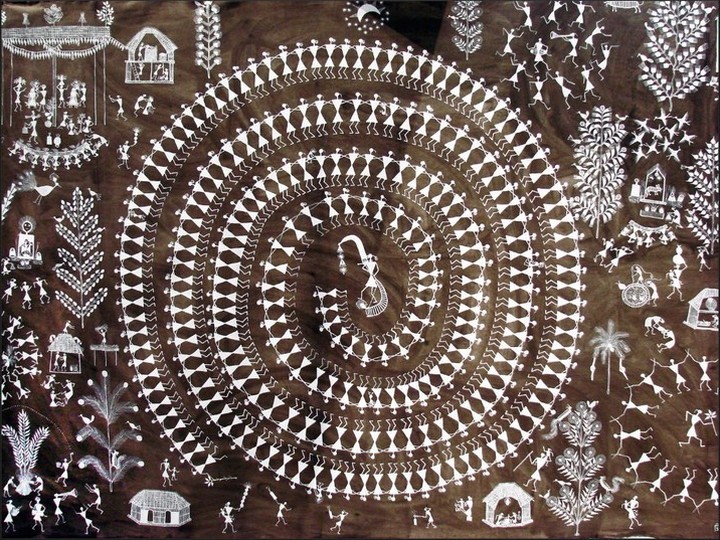
Warli tribal wall-art panel
Ochre-and-white ritual art of the Warli people, painted onto panel for the modern home
| Origin | Maharashtra, India |
| Indian subcontinent | Yes |
| Category | Art & Heritage Objects |
| Retail price band | budget |
| Bulk / trade price band | budget (high-volume wholesale panels) |
| Sourcing status | Dossier researched from public sources — producer contact not yet established |
| Compliance status | Preliminary review complete (see below) — not yet legally verified |
Detailed study
Warli art uses a minimal white-on-earthen-red/brown palette (traditionally rice paste, gum, and water applied with a chewed bamboo stick on cow-dung-plastered walls) to build human, animal, and tree figures from basic geometric forms — circles, triangles, and squares — depicting harvests, hunts, marriages, and the central Tarpa dance motif. Commercial panels reproduce this technique on canvas, wood, or handmade paper for wall decor.
Provenance & producer
Warli painting originates with the Warli (Varli) Adivasi tribal community of the Sahyadri hill range spanning Maharashtra's Palghar/Thane/Nashik districts and neighbouring Gujarat/Dadra & Nagar Haveli, one of India's oldest continuous tribal art traditions, popularized nationally from the 1970s largely through the work of Padma Shri artist Jivya Soma Mashe. Warli painting has received GI-tag recognition as a Maharashtra tribal handicraft.
Market & pricing
Warli panels are a high-volume, accessible entry point into Indian tribal/folk decor, sold from mass tourist-market price points up to higher-value signed works by recognized Warli master artists; the style is widely licensed onto textiles, ceramics, and stationery, which has driven both demand and a large market for unauthorized machine-printed 'Warli-style' imitation goods. Primary buyers are home-decor retailers, ethical/tribal-craft gift shops, and export wholesalers targeting global ethnic-decor demand.
Compliance & export
Because GI protection and community-attribution efforts (including recent GI-tag drives led by Warli women's cooperatives) are actively being formalized, retailers should be able to document that panels are hand-painted by Warli artisans rather than machine-printed reproductions sold under the same name; standard Indian handicraft export documentation applies, and fair-trade/artisan-income disclosure is increasingly expected by Western ethical-sourcing buyers given the tribe's Scheduled Tribe socio-economic status.
Sources
- Warli painting - Wikipedia
- Adivasi Women Are Reclaiming Centuries-Old Warli Art With GI-Tags - The Better India
- Warli Painting in Maharashtra - Incredible India
Image status
A working reference photograph is in place, captured from a freely-licensed Wikimedia Commons source (File:A Warli painting by Jivya Soma Mashe, Thane district.jpg). Depicts an authentic work by the tradition's best-known master artist, Jivya Soma Mashe — verify licence on the Commons page before use. Treat this as a placeholder for marketing purposes: exact licence terms should be re-verified on the Commons file page, and original producer photography is recommended before final trade use.