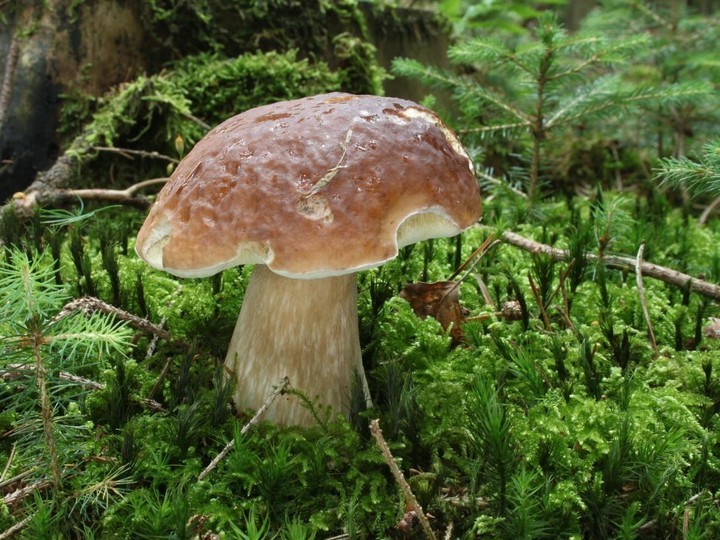
Wild Boletus edulis, Kashmir conifer belt
Wild porcini (Boletus edulis) foraged from Kashmir's deodar-and-pine conifer belt — a scientifically documented but commercially under-established species, distinct from Kashmir's better-known morel (gucchi) trade.
| Origin | Kashmir Himalaya, India — the species claim is scientifically defensible (Boletus edulis is documented in wild-mushroom diversity surveys of Jammu & Kashmir and is associated with deodar/pine ectomycorrhizal forests per regional mycology research), but Kashmir's globally famous, high-value wild fungus trade is actually morel (gucchi/Morchella spp., ₹20,000–40,000/kg per trade press), not Boletus edulis — recommend describing this as "wild Boletus edulis, recorded in Kashmir's conifer forests" rather than implying an established commercial porcini trade comparable to gucchi |
| Indian subcontinent | Yes |
| Category | Fungi & Functional Mycology |
| Retail price band | No verified retail Indian market price for wild Boletus edulis was found; European/global porcini (fresh, in-season) typically trades at premium prices (often cited in the €20–60/kg range in Western Europe) — an international reference point only, not a confirmed Kashmir price |
| Bulk / trade price band | No verified bulk/trade price for Kashmir-sourced Boletus edulis was found; unlike gucchi (Kashmir's documented ₹20,000–40,000/kg wild fungus), there is no established commercial trade channel identified for Kashmir porcini in this research |
| Sourcing status | Dossier researched from public sources — producer contact not yet established |
| Compliance status | Preliminary review complete (see below) — not yet legally verified |
Detailed study
Boletus edulis is recorded in scientific surveys of wild mushroom diversity in Jammu & Kashmir and in ectomycorrhizal studies of Cedrus deodara (deodar) and Pinus wallichiana forests in the Kashmir Himalaya, confirming the species does occur in the region's conifer belt; it is also noted in Kashmir mycology literature for antitumor/antiviral bioactive properties.
Provenance & producer
Unlike Kashmir's gucchi (morel), which has a well-documented forager-to-trader supply chain concentrated in Anantnag, Kupwara and Kangan forest ranges above 2,000m, no equivalent documented commercial foraging/trading network specifically for Boletus edulis in Kashmir was found — wild collection, where it occurs, would likely be informal/subsistence-level rather than an established export trade.
Market & pricing
No Indian trade listings (IndiaMART/TradeIndia) or market-price data for wild Kashmir Boletus edulis were found; by contrast, Kashmir gucchi (morel) has clearly documented pricing (₹20,000–40,000/kg) — this pricing gap itself is evidence the Boletus edulis Kashmir trade is not currently an established commercial category, and any price presented to buyers should be clearly framed as indicative/international rather than a verified Kashmir trade rate.
Compliance & export
Wild fungi foraging in Jammu & Kashmir is not covered by a specific licensing regime found in this research, but general Indian Forest Rights Act provisions and state forest department rules govern community harvesting of forest produce; export of wild-collected fungi would require standard phytosanitary/APEDA documentation, and buyers should be advised that species identification of wild boletes carries genuine misidentification risk given documented look-alike and newly described Boletaceae species from India.
Sources
- Diversity of wild mushrooms from Jammu and Kashmir (ResearchGate)
- Down to Earth: gucchi, mushroom of the royal (Kashmir)
- Ectomycorrhizal diversity, Cedrus deodara and Pinus wallichiana, Kashmir Himalaya
- New Boletaceae species from India (Mycological Progress)
- India's wild edible fungi, Kashmir gucchi pricing (fedfedfed)
Image status
A working reference photograph is in place, captured from a freely-licensed Wikimedia Commons source (File:Boletus_edulis_steinpilz.jpg). Wikimedia Commons file; verify exact licence (commonly CC-BY-SA) on the file page before use Treat this as a placeholder for marketing purposes: exact licence terms should be re-verified on the Commons file page, and original producer photography is recommended before final trade use.