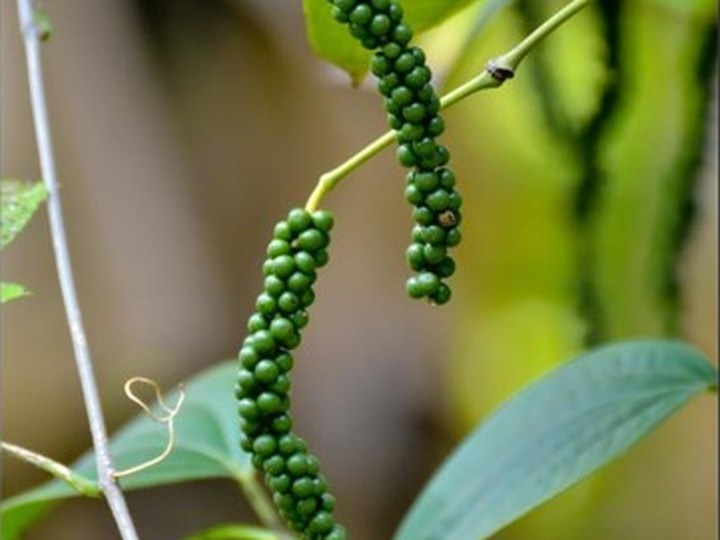
Wild forest pepper (Malabar wild pepper vine)
Grown on living support trees across Wayanad's misty Western Ghats hillsides, GI-tagged Malabar pepper is the spice that first drew global trade to India's coast over two millennia ago.
| Origin | Malabar pepper is a cultivated GI-registered crop grown on trees/live standards across Kerala's Western Ghats districts (notably Wayanad, Idukki), not a wild-foraged forest product — no credible commercial evidence of a distinct 'wild forest pepper' trade category was found; correct to 'Cultivated GI-tagged Malabar black pepper, Wayanad/Idukki, Western Ghats, Kerala.' |
| Indian subcontinent | Yes |
| Category | Rare Spices, Botanicals & Teas |
| Retail price band | Retail farm-gate/mandi black pepper prices in Wayanad have recently run roughly ₹450–650/kg per organic/branded sellers and mandi price trackers |
| Bulk / trade price band | Bulk organic Wayanad black pepper listed around ₹450/kg on IndiaMART trade listings |
| Sourcing status | Dossier researched from public sources — producer contact not yet established |
| Compliance status | Preliminary review complete (see below) — not yet legally verified |
Detailed study
Black pepper (Piper nigrum), the 'king of spices,' is a perennial woody vine traditionally trained up living support trees (areca, silver oak, jackfruit) in Kerala's Western Ghats homegardens rather than grown as a wild forest plant in significant commercial volume. Grading considers berry size, density (measured in grams per liter, e.g. the TGSEB/500 g/l+ grades used in export contracts), piperine content, and moisture; genuinely feral/naturalized pepper vines do occur at forest margins in the Western Ghats but are not documented as a distinct, separately graded commercial trade category, unlike cultivated Malabar pepper.
Provenance & producer
Malabar pepper is grown by smallholder farmers across Kerala's Western Ghats districts, especially Wayanad and Idukki, typically intercropped with coffee, cardamom and areca nut in traditional multi-tier agroforestry systems that have supported pepper cultivation for well over a thousand years, historically driving Kerala's role as a global spice-trade hub. 'Malabar Pepper' is a registered Geographical Indication administered by the Spices Board of India, recognizing pepper grown in this historic Malabar Coast region.
Market & pricing
Regional mandi price trackers and organic-branded sellers show Wayanad black pepper trading roughly in the ₹450–650/kg range through 2025, with premium organic/GI-verified lots commanding the higher end; the Malabar Pepper GI is framed as a tool to help farmers secure higher, more stable prices versus generic pepper.
Compliance & export
'Malabar Pepper' holds a registered GI tag through the Spices Board of India / GI Registry system; as a food spice, domestic sale requires FSSAI compliance and export requires Spices Board registration and standard phytosanitary certification. There is no CITES or forest-produce restriction since cultivated pepper is an agricultural crop, but the catalogue's 'wild forest pepper' framing should be corrected to avoid implying a foraged/non-cultivated product that could mislead buyers or regulators evaluating supply-chain claims.
Sources
- Krishijagran — Malabar Pepper: A GI-Tagged Black Gold Crop
- Malabar pepper — Wikipedia
- IndiaMART — Organic Wayanadan Black Pepper, ₹450/kg
Image status
A working reference photograph is in place, captured from a freely-licensed Wikimedia Commons source (File:Black Pepper (Piper nigrum) fruits.jpg). Correctly depicts Piper nigrum fruit clusters; not confirmed to be a Wayanad/Kerala-specific photo, so use as a generic botanical reference. Standard Commons licensing applies — verify exact CC terms on file page. Treat this as a placeholder for marketing purposes: exact licence terms should be re-verified on the Commons file page, and original producer photography is recommended before final trade use.