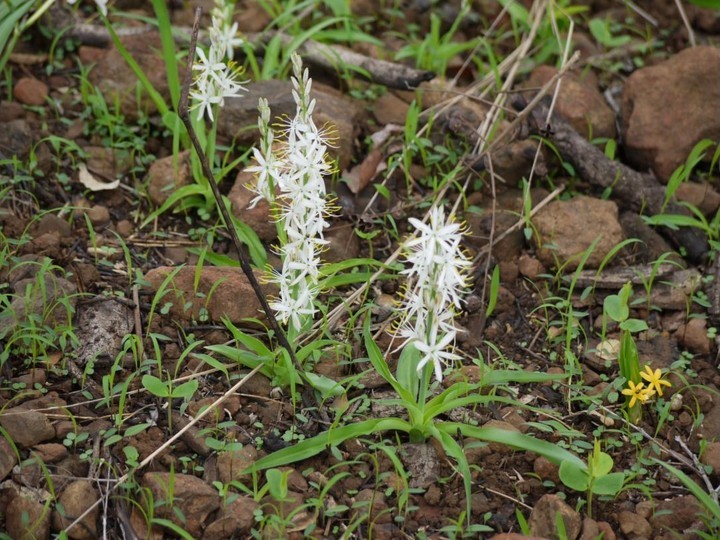
Wild-harvested Safed Musli tuber extract
Central India's revered tonic root — today grown, not gathered, to protect a vanishing wild plant.
| Origin | Wild Chlorophytum borivilianum populations are documented as heavily depleted and endangered across their native range due to decades of overharvesting for the herbal trade; nearly all commercial 'Safed Musli' sold today — including from Madhya Pradesh — is field-cultivated (often contract-farmed as a cash crop dubbed 'white gold') rather than genuinely wild-harvested. The catalogue's 'wild-harvested' claim is very likely inaccurate for bulk commercial supply and should be corrected to 'cultivated' unless batch-specific wild-collection documentation (increasingly rare and often illegal without permits) can be verified. |
| Indian subcontinent | Yes |
| Category | Ayurveda & Wellness Extracts |
| Retail price band | mid |
| Bulk / trade price band | wholesale, cultivated-crop contract-farming pricing |
| Sourcing status | Dossier researched from public sources — producer contact not yet established |
| Compliance status | Preliminary review complete (see below) — not yet legally verified |
Detailed study
Safed Musli (Chlorophytum borivilianum) is a tuberous-rooted herb valued in Ayurveda as a rasayana and vitalizing tonic; its finger-like tubers contain saponins, alkaloids, polysaccharides and over 25 identified phytochemicals studied for antioxidant, anti-inflammatory and adaptogenic properties. Processing involves careful hand-peeling and shade-drying of tubers immediately after harvest to prevent discoloration and preserve mucilage content.
Provenance & producer
Native to tropical moist forests of peninsular India, the species' wild stands (historically found in Madhya Pradesh, Rajasthan, Gujarat and Chhattisgarh) have been so heavily overharvested that wild populations are now classified as endangered in several regions. Today the overwhelming majority of commercial 'Safed Musli' is deliberately cultivated on smallholder and contract farms across these same states, grown in sandy loam soil under irrigation as a lucrative cash crop, with cultivation actively promoted to relieve pressure on remaining wild stock.
Market & pricing
Safed Musli extract is sold across Ayurvedic-classical, nutraceutical and men's-vitality supplement markets in India and for export, commanding mid-tier pricing that fluctuates with contract-farming yields; buyers include Ayurvedic pharmaceutical houses, herbal export traders and dietary-supplement formulators. Persistent challenges include root adulteration with cheaper Chlorophytum species and inconsistent standardization of saponin content across suppliers.
Compliance & export
Because wild C. borivilianum populations are conservation-depleted, any wild-harvest claim should be treated skeptically and, where used, backed by forest-department collection permits; cultivated sourcing is the responsible and verifiable default and should be clearly labeled as such rather than marketed as wild. In India, Safed Musli products fall under AYUSH/FSSAI regulation depending on classical-drug vs. food-supplement positioning; for export to the US/EU it is regulated as a dietary supplement (FDA DSHEA, EU food-supplement/novel-food rules) requiring accurate botanical-source labeling to avoid misrepresenting cultivated material as wildcrafted.
Sources
- Wikipedia: Chlorophytum borivilianum
- Conservational studies on Chlorophytum borivilianum, Nandurbar
- Production techniques for cultivation of Safed Musli
- SSP Group: Safed Musli Contract Farming in India
Image status
A working reference photograph is in place, captured from a freely-licensed Wikimedia Commons source (File:Chlorophytum borivilianum (4695352035).jpg). Typically CC BY 2.0 for Flickr-sourced botanical images; depicts the living plant. Treat this as a placeholder for marketing purposes: exact licence terms should be re-verified on the Commons file page, and original producer photography is recommended before final trade use.