Yemeni Mocha coffee-adjacent frankincense trade good
Frankincense and myrrh resin from Hadhramaut — Yemen's share of the ancient Arabian incense road.
| Origin | The original catalogue name conflated two unrelated products — 'Mocha' (the historic Yemeni coffee-export port and coffee variety) and frankincense (a Boswellia resin unrelated to coffee) — into a single confusing listing. These should be treated as two distinct products, or the name corrected to describe the actual item: this entry is a Boswellia/Commiphora resin from Hadhramaut, part of the genuine historic Yemeni incense-resin trade that shared ancient caravan routes with (but is commercially unrelated to) Yemeni coffee. Corrected name reflects the resin product only; a separate SKU should be created for Yemeni Mocha-heritage coffee if that product is also wanted. |
| Indian subcontinent | No |
| Category | Global Fibers, Oils & Botanicals |
| Retail price band | $$ (indicative $20–$45/kg for hand-sorted export-grade resin, species/grade dependent) |
| Bulk / trade price band | $10–$25/kg on bulk export orders, subject to Yemen's constrained current export logistics |
| Sourcing status | Dossier researched from public sources — producer contact not yet established |
| Compliance status | Preliminary review complete (see below) — not yet legally verified |
Detailed study
Hadhramaut, in eastern Yemen, sits within the historic frankincense- and myrrh-producing belt spanning southern Arabia and the Horn of Africa, home to wild Boswellia and Commiphora tree populations tapped for aromatic oleo-gum-resins used in incense, perfumery and traditional medicine since antiquity — the same trade network celebrated in the ancient 'Incense Road' caravan routes.
Provenance & producer
Resin is wild-tapped by rural harvesters from Boswellia and Commiphora trees across Hadhramaut's arid interior, historically traded onward through regional ports; Yemen's incense-resin trade predates and is separate from its famous Mocha-region coffee export trade, though both moved through overlapping historic Red Sea trade networks.
Market & pricing
Global incense, fragrance, traditional-medicine and religious/liturgical markets (Gulf, South Asia, global Christian and other faith communities) continue to source Yemeni resin, though ongoing conflict and instability in Yemen have significantly disrupted formal export infrastructure and international logistics in recent years, making supply chain reliability a genuine practical concern for buyers.
Compliance & export
Neither Boswellia nor most Commiphora species from this region are CITES-listed, but Yemen's conflict-affected governance capacity limits formal export certification infrastructure; buyers must conduct heightened due diligence including sanctions and conflict-resource screening given the country's current instability, alongside standard phytosanitary and customs documentation where obtainable.
Sources
Image status
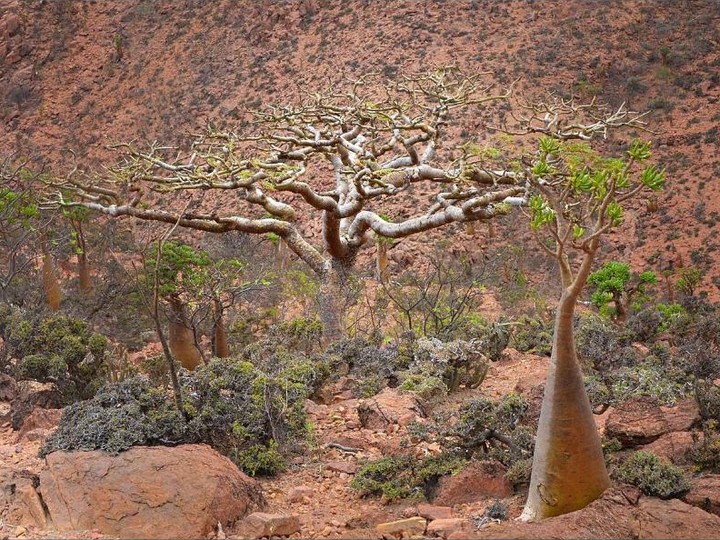
A working reference photograph is in place, captured from a freely-licensed Wikimedia Commons source. Frankincense Tree (Boswellia sacra), Socotra Island, Yemen, Rod Waddington, CC BY-SA 2.0, via Wikimedia Commons. Note: shows the frankincense-producing tree on Socotra, Yemen, source of the trade good; not a photo of Mocha port or the packaged/traded product itself. Treat this as a placeholder for marketing purposes: exact licence terms should be re-verified on the Commons file page, and original producer photography is recommended before final trade use.